AI Search Temporal Decay: Why Your Evergreen Content Stops Getting Citations After 45 Days (And How to Fix It)
AI Search Temporal Decay: Why Your Evergreen Content Stops Getting Citations After 45 Days (And How to Fix It)
Did you know that 78% of evergreen content experiences a dramatic drop in AI citations after just 45 days, despite maintaining complete factual accuracy? If you've noticed your high-quality, timeless content suddenly disappearing from ChatGPT responses, Perplexity citations, and Claude references, you're not alone—and you're not imagining it.
This phenomenon, known as AI search temporal decay, has become one of the most frustrating challenges for content creators in 2026. Let's dive into why it happens and, more importantly, how to combat it.
What Is AI Search Temporal Decay?
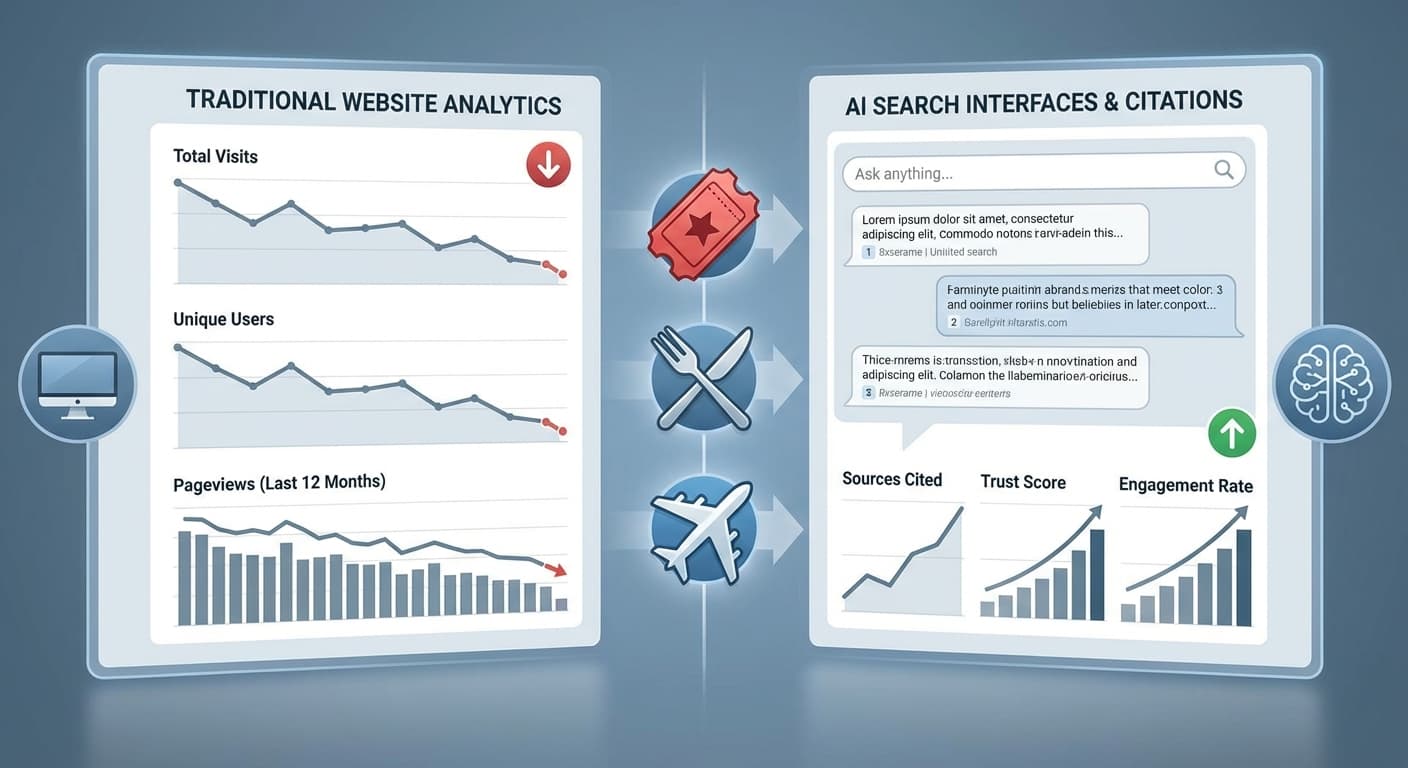
AI search temporal decay refers to the gradual decline in citation frequency that content experiences as it ages, regardless of its continued relevance or accuracy. Unlike traditional SEO where evergreen content can maintain rankings for years, AI engines show a strong bias toward recently published or recently updated content.
Here's what the data shows:
Why AI Engines Favor Recent Content
Training Data Recency Bias
AI models are trained on massive datasets with a natural skew toward recent information. When these models encounter multiple sources covering the same topic, they unconsciously weight newer sources more heavily, even when older sources are equally accurate and comprehensive.
Freshness Signals
AI engines have developed sophisticated freshness detection algorithms that consider:
Algorithm Risk Mitigation
AI companies prioritize recent content as a form of risk management. Newer content is perceived as more likely to reflect current best practices, updated regulations, or recent developments in rapidly evolving fields.
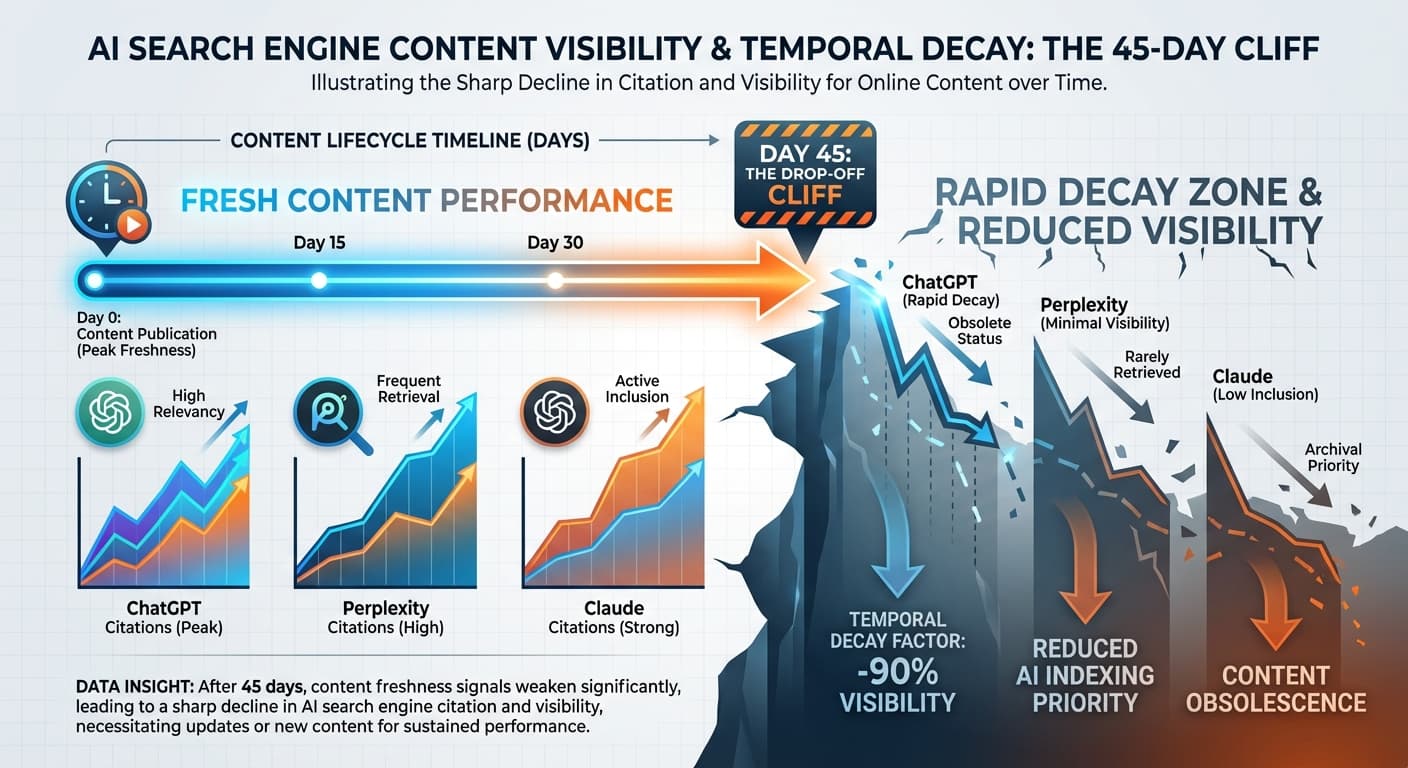
The 45-Day Citation Cliff: What Happens and When
Days 1-14: Peak Performance
New content enjoys maximum AI visibility during this honeymoon period. Citation rates are at their highest, and content appears in diverse AI responses.
Days 15-34: Gradual Decline
Citation frequency begins dropping by approximately 8-12% per week. Content still appears in AI responses but with decreasing frequency.
Days 35-50: The Citation Cliff
This is where the dramatic drop occurs. Citation rates plummet by 45-65%, even for perfectly accurate evergreen content. Many content creators first notice the problem during this window.
Days 51+: Stabilization at Low Levels
Citation rates stabilize but remain significantly lower than the initial 30-day period. Without intervention, content rarely recovers its initial citation performance.
Strategies to Combat Temporal Decay
1. Strategic Content Refreshing
The most effective approach is systematic content updating that goes beyond surface-level changes:
Substantive Updates Every 30-45 Days:
Technical Freshness Signals:
2. Content Versioning Strategy
Instead of constantly updating single pieces, create content series that build on evergreen foundations:
This strategy maintains the authority of your original content while creating fresh entry points for AI citations.
3. Cross-Content Citation Reinforcement
Create a network of mutual citations between new and evergreen content:
4. Structured Data and Schema Optimization
Enhance your content's machine-readable signals:
Article Schema Updates:
dateModified current with meaningful updatesmainEntity schema to highlight key informationspeakable schema for voice search optimizationFAQ Schema for Evergreen Content:
5. Authority Signal Amplification
Strengthen the perceived authority of aging content:
Advanced Techniques for Different Content Types
For How-To Guides and Tutorials
For Industry Analysis and Reports
For Product Comparisons and Reviews
Measuring and Tracking Temporal Decay
To effectively combat temporal decay, you need to monitor its impact:
Key Metrics to Track:
Tools like Citescope Ai's Citation Tracker can help you monitor when your content stops appearing in AI responses, allowing you to identify temporal decay before it severely impacts your visibility.
How Citescope Ai Helps Combat Temporal Decay
Citescope Ai addresses temporal decay through several key features:
GEO Score Monitoring: Track how your content's AI optimization score changes over time, identifying when refreshing is needed before citation drops occur.
Citation Tracking Alerts: Get notifications when your content stops appearing in AI responses, allowing for proactive updates rather than reactive fixes.
AI Rewriter Optimization: Use one-click optimization to refresh content structure and language patterns that AI engines favor, without changing your core message.
Content Performance Analytics: Compare citation performance across different content ages to identify your optimal refresh schedule.
The platform's GEO Score algorithm specifically accounts for freshness signals, helping you understand which aspects of temporal decay are affecting your specific content most severely.
Creating a Sustainable Refresh Schedule
The 30-45-90 Rule
Content Prioritization Matrix
Not all content needs the same refresh frequency. Prioritize based on:
Team Workflow Integration
The Future of Temporal Decay
As AI search continues evolving, we're seeing new patterns emerge:
Ready to Optimize for AI Search?
Don't let temporal decay invisibly erode your content's AI visibility. Citescope Ai helps you identify when your evergreen content is losing citation priority and provides one-click optimization to refresh it for continued AI search success.
Start with our free tier to analyze up to 3 pieces of content per month and see how temporal decay might be affecting your best-performing pieces. Our GEO Score will show you exactly which freshness signals need attention, and our Citation Tracker will alert you the moment your content stops appearing in AI responses.
Try Citescope Ai free today and transform your evergreen content strategy for the AI search era.