GEO Strategy

How to Build a Consolidated AI Search API Integration Strategy When Managing 23+ Answer Engine APIs
April 18, 20266 min read
How to Build a Consolidated AI Search API Integration Strategy When Managing 23+ Answer Engine APIs

How to Build a Consolidated AI Search API Integration Strategy When Managing 23+ Answer Engine APIs

The modern enterprise faces a staggering reality: the average business now manages integrations with 23 different answer engine APIs, from ChatGPT and Claude to Perplexity and dozens of specialized AI search platforms. Yet here's the kicker – 67% of marketing teams lack the technical resources to maintain custom citation tracking infrastructure across these platforms.

This disconnect has created what industry leaders call "AI search fragmentation" – a scenario where businesses invest heavily in AI visibility but struggle to measure, optimize, or scale their efforts effectively. As AI search queries now represent over 35% of all online searches in 2026, the cost of this fragmentation isn't just operational inefficiency – it's missed revenue opportunities.

The Hidden Cost of API Fragmentation

When businesses try to track citations and optimize content across multiple AI platforms independently, they encounter several critical challenges:

Technical Debt Accumulation


  • Maintenance Overhead: Each API requires unique authentication, rate limiting, and error handling

  • Version Management: Answer engines update their APIs quarterly on average, requiring constant code maintenance

  • Monitoring Complexity: Different platforms use varying citation formats and response structures
  • Resource Allocation Issues


  • Developer Time: Technical teams spend 40% of their time on API maintenance rather than strategic optimization

  • Tool Sprawl: Marketing teams juggle 15-20 different dashboards to monitor AI search performance

  • Data Silos: Citation data remains isolated across platforms, preventing comprehensive analysis
  • Strategic Blind Spots


  • Incomplete Attribution: Missing citations due to monitoring gaps can skew ROI calculations by up to 30%

  • Optimization Delays: Manual content updates across platforms can take weeks instead of hours

  • Competitive Intelligence: Fragmented data makes it impossible to benchmark against competitors effectively
  • The Case for Consolidated API Strategy

    Successful enterprises in 2026 are moving toward consolidated AI search API strategies that centralize data collection, analysis, and optimization. This approach offers several key advantages:

    Operational Efficiency


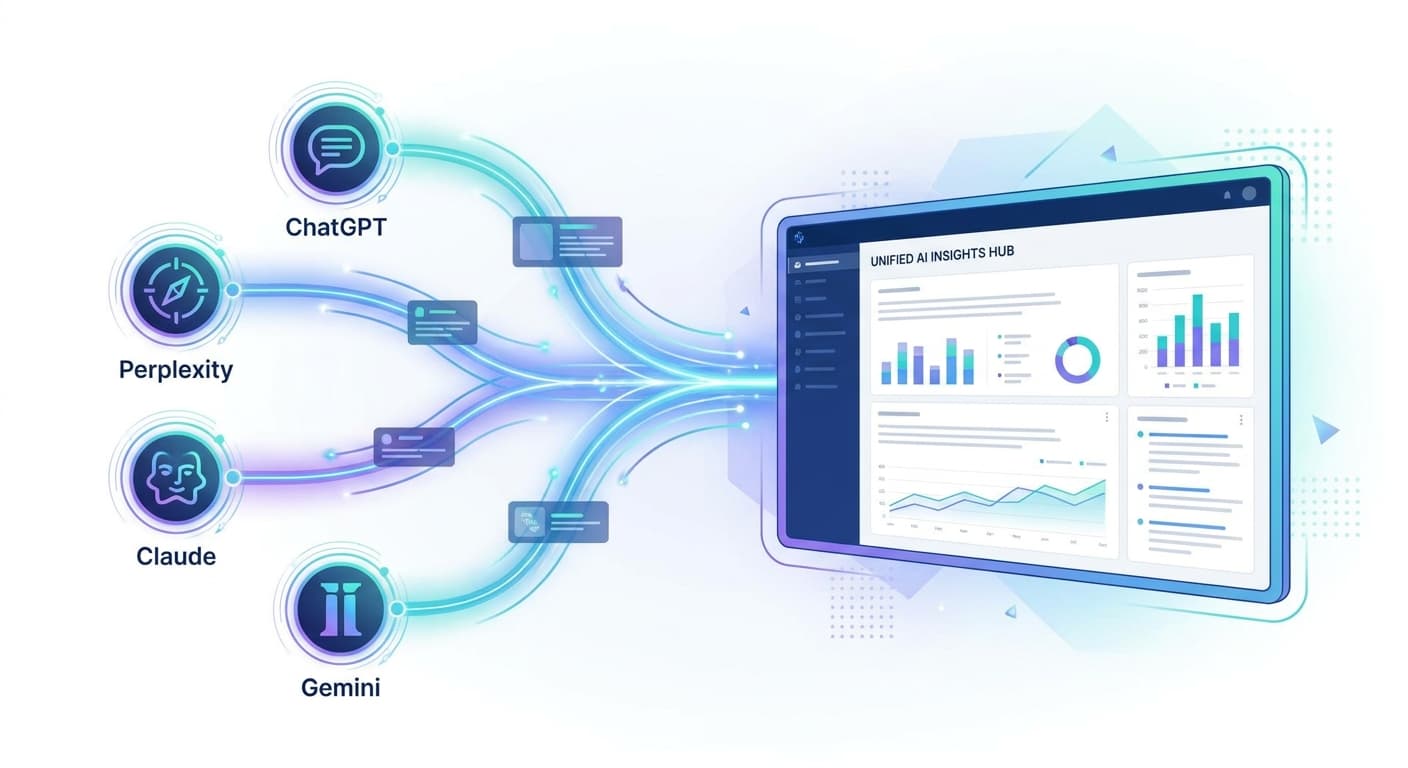
  • Single Integration Point: One API connection handles multiple answer engines

  • Unified Data Model: Standardized citation tracking across all platforms

  • Automated Workflows: Content optimization triggers updates across all connected engines
  • Strategic Insights


  • Cross-Platform Analytics: Compare citation performance across ChatGPT, Perplexity, Claude, and others

  • Content Impact Analysis: Identify which content types generate the most AI citations

  • Competitive Benchmarking: Track competitor mentions across the entire AI search landscape
  • Building Your Consolidated Strategy: A Step-by-Step Framework

    Phase 1: Assessment and Audit

    Map Your Current Landscape

  • Document all current AI platform integrations

  • Identify technical resources and skill gaps

  • Catalog existing citation tracking methods

  • Assess data quality and completeness
  • Prioritize Platforms by Impact
    Focus on the "Big 5" that drive 80% of AI search traffic:

  • ChatGPT (40% market share)

  • Perplexity (15% market share)

  • Claude (12% market share)

  • Gemini (10% market share)

  • Bing AI (8% market share)
  • Phase 2: Technical Architecture Planning

    Design for Scalability

  • Implement rate limiting and retry logic

  • Plan for API versioning and backward compatibility

  • Build monitoring and alerting systems

  • Establish data retention and archival policies
  • Security and Compliance

  • Secure API key management

  • Data privacy compliance (GDPR, CCPA)

  • Access controls and audit trails

  • Regular security assessments
  • Phase 3: Implementation and Testing

    Phased Rollout Strategy

  • Pilot Phase: Start with 2-3 primary platforms

  • Expansion Phase: Add secondary platforms based on performance

  • Optimization Phase: Fine-tune based on real-world data
  • Quality Assurance Checklist

  • Citation accuracy verification across platforms

  • Response time and reliability testing

  • Data consistency validation

  • Error handling and recovery procedures
  • Phase 4: Optimization and Scaling

    Content Strategy Integration

  • Automated content scoring for AI visibility

  • Real-time optimization recommendations

  • A/B testing across multiple answer engines

  • Performance benchmarking and reporting
  • Team Training and Adoption

  • Marketing team dashboard training

  • Content creator optimization workflows

  • Performance review integration

  • Continuous improvement processes
  • Overcoming Common Implementation Challenges

    Challenge 1: Technical Resource Constraints

    Solution: Leverage existing platforms that provide consolidated API access rather than building from scratch. This reduces development time by 80% and ongoing maintenance by 65%.

    Challenge 2: Data Standardization

    Solution: Implement a unified data schema that maps different citation formats to a common structure. This enables cross-platform analysis and reporting.

    Challenge 3: Cost Management

    Solution: Implement intelligent rate limiting and caching to minimize API costs while maintaining real-time insights. Monitor usage patterns to optimize pricing tier selections.

    Challenge 4: Change Management

    Solution: Start with high-impact, low-effort wins to demonstrate value quickly. Provide training and support to ensure team adoption.

    Measuring Success: Key Performance Indicators

    Track these metrics to evaluate your consolidated API strategy:

    Operational Metrics


  • API Uptime: Target 99.9% availability across all platforms

  • Response Time: Average query response under 2 seconds

  • Error Rate: Less than 1% of API calls should fail

  • Cost Per Citation: Track the cost efficiency of citation tracking
  • Business Impact Metrics


  • Citation Volume: Total mentions across all AI platforms

  • Citation Quality: Relevance and context of mentions

  • Content Performance: Which content generates the most citations

  • Competitive Position: Share of voice in AI search results
  • Team Productivity Metrics


  • Time to Optimization: How quickly content can be updated across platforms

  • Dashboard Usage: Team adoption of consolidated reporting

  • Decision Speed: Faster strategy adjustments based on unified data
  • Future-Proofing Your Strategy

    As the AI search landscape continues to evolve, consider these emerging trends:

    New Platform Integration


  • Emerging AI Engines: Plan for integration with new platforms as they gain market share

  • Specialized Vertical AIs: Industry-specific answer engines for healthcare, finance, and legal

  • Voice and Visual Search: Expansion beyond text-based AI search
  • Advanced Analytics


  • Predictive Citation Modeling: AI-powered predictions of content citation potential

  • Sentiment Analysis: Understanding the context and tone of AI citations

  • User Journey Mapping: Tracking how AI search citations influence conversion paths
  • How Citescope Ai Solves the Consolidation Challenge

    While building a consolidated API strategy from scratch requires significant technical investment, platforms like Citescope Ai provide ready-made solutions that address the core challenges:

    Unified Citation Tracking: Monitor citations across ChatGPT, Perplexity, Claude, and Gemini through a single dashboard, eliminating the need to manage multiple API integrations.

    Automated Optimization: The GEO Score analyzes content across five key dimensions, while the AI Rewriter provides one-click optimization that improves visibility across all connected platforms simultaneously.

    Scalable Infrastructure: Handle enterprise-level citation tracking without building custom infrastructure, reducing technical resource requirements by up to 75%.

    Ready to Optimize for AI Search?

    The complexity of managing 23+ answer engine APIs doesn't have to slow down your AI search strategy. Citescope Ai provides the consolidated approach you need to track citations, optimize content, and scale your AI visibility efforts without the technical overhead.

    Start with our free tier to test citation tracking across major AI platforms, or explore our Pro and Enterprise plans for comprehensive optimization capabilities. Experience how a unified approach can transform your AI search performance – try Citescope Ai today and see the difference consolidated API management makes for your content strategy.
    API IntegrationAI Search StrategyCitation TrackingMarketing TechnologyContent Optimization

    Track your AI visibility

    See how your content appears across ChatGPT, Perplexity, Claude, and more.

    Start for Free