AI & SEO

How to Build a Hallucination Detection System When AI Search Engines Like ChatGPT and Perplexity Are Citing Your Brand Incorrectly and Costing You Sales
January 29, 20267 min read
How to Build a Hallucination Detection System When AI Search Engines Like ChatGPT and Perplexity Are Citing Your Brand Incorrectly and Costing You Sales

How to Build a Hallucination Detection System When AI Search Engines Like ChatGPT and Perplexity Are Citing Your Brand Incorrectly and Costing You Sales

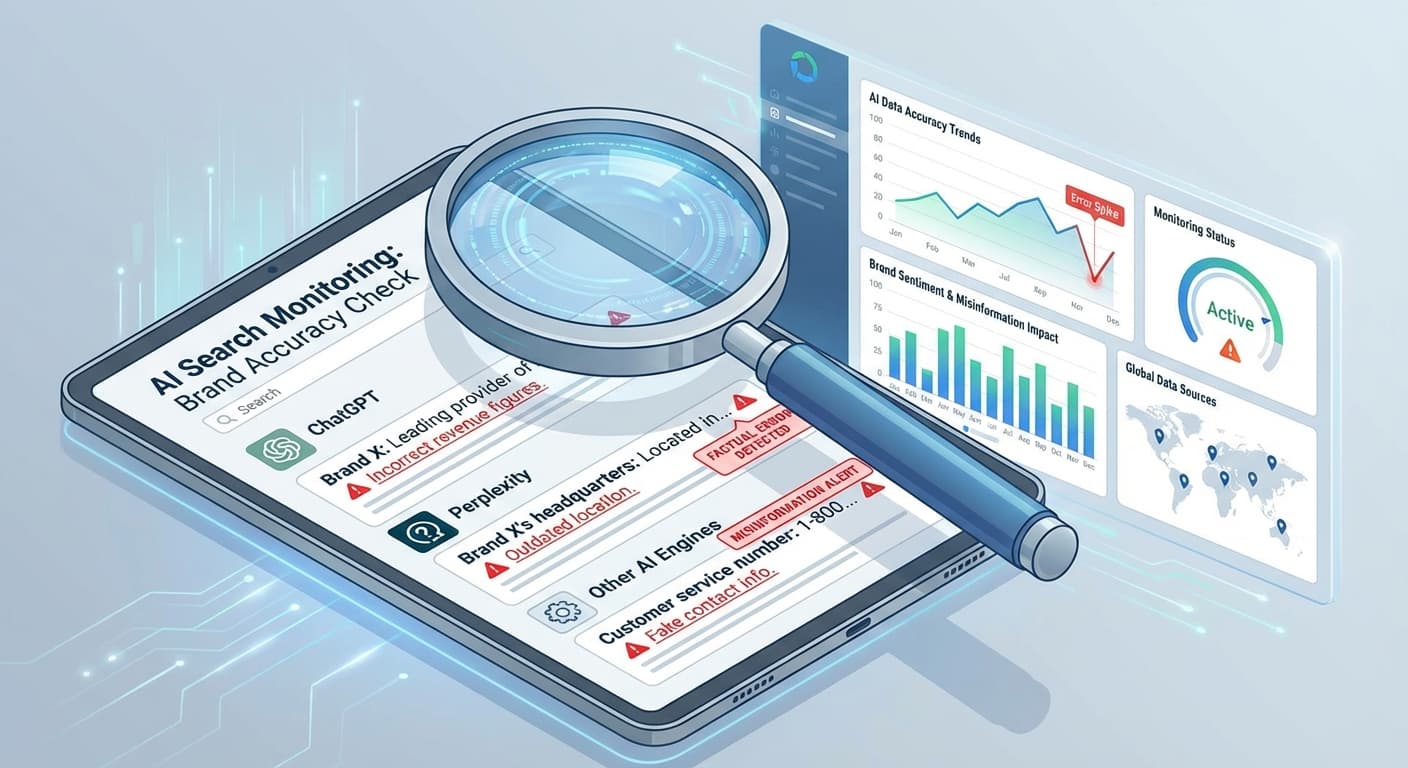
A Fortune 500 SaaS company recently discovered that ChatGPT was telling 30% of users their pricing was $200/month higher than reality. The cost? An estimated $2.3 million in lost revenue over six months. Welcome to the hidden crisis of AI hallucinations – where search engines confidently cite your brand with completely fabricated information.

With AI search now handling over 35% of all queries in 2026 and ChatGPT alone serving 600 million weekly users, AI hallucinations about your brand aren't just an inconvenience – they're a business-critical threat that requires systematic detection and correction.

The Growing Crisis of Brand Misinformation in AI Search

AI hallucinations occur when language models generate confident-sounding but factually incorrect information. For brands, this manifests as:

  • Pricing misinformation: AI engines stating incorrect product costs or subscription tiers

  • Feature fabrication: Describing capabilities your product doesn't have

  • Competitive positioning errors: Misrepresenting your market position or comparing you incorrectly to competitors

  • Company details mistakes: Wrong founding dates, leadership information, or business models

  • Product availability issues: Claiming discontinued products are still available or vice versa
  • Recent studies show that 23% of AI-generated responses about specific brands contain at least one factual error, with pricing and feature information being the most commonly hallucinated elements.

    Why Traditional Brand Monitoring Falls Short

    Conventional brand monitoring tools weren't designed for AI search engines. They typically focus on:

  • Social media mentions

  • News articles and blogs

  • Review sites and forums

  • Traditional search results
  • But AI engines don't just aggregate existing content – they synthesize and reinterpret information, creating novel combinations that can introduce errors even when source materials are accurate.

    Building Your AI Hallucination Detection System: A Step-by-Step Framework

    Step 1: Map Your Brand's Critical Information Points

    Start by cataloging the facts AI engines should know about your brand:

    Essential Brand Facts:

  • Current pricing across all tiers and markets

  • Core product features and capabilities

  • Company founding information and key milestones

  • Leadership team and organizational structure

  • Geographic availability and restrictions

  • Partnership and integration details
  • Create a "Brand Truth Database" – a comprehensive, regularly updated document that serves as your reference point for fact-checking AI responses.

    Step 2: Develop Comprehensive Query Testing

    Create systematic test queries that cover your brand from multiple angles:

    Direct Brand Queries:

  • "What does [Brand Name] cost?"

  • "What features does [Product Name] include?"

  • "Who founded [Company Name] and when?"
  • Comparison Queries:

  • "[Your Brand] vs [Competitor] pricing"

  • "Best alternatives to [Your Product]"

  • "[Your Brand] features compared to [Competitor]"
  • Use Case Queries:

  • "Best [product category] for [specific use case]"

  • "How to solve [problem] with [your industry] tools"

  • "[Your Brand] integration with [popular platforms]"
  • Run these queries across multiple AI engines – ChatGPT, Claude, Gemini, and Perplexity often provide different responses, and hallucinations may appear in some but not others.

    Step 3: Implement Automated Monitoring

    Set up systems to regularly test AI responses:

    Daily Monitoring:

  • Core pricing and product information

  • Recent product updates or announcements

  • Competitive positioning claims
  • Weekly Deep Dives:

  • Comprehensive feature descriptions

  • Company background and history

  • Integration and partnership details
  • Monthly Audits:

  • Industry positioning and market analysis

  • Comparison with competitors

  • Long-form explanatory content
  • Step 4: Create a Hallucination Severity Classification

    Critical Hallucinations (Immediate Action Required):

  • Incorrect pricing information

  • False claims about product availability

  • Fabricated features that could lead to disappointed customers

  • Misrepresented company ownership or business model
  • Moderate Hallucinations (Address Within 48 Hours):

  • Outdated feature descriptions

  • Incorrect company background details

  • Mispositioned competitive comparisons
  • Minor Hallucinations (Weekly Review):

  • Slight inaccuracies in company history

  • Generalized feature descriptions that aren't quite right

  • Approximate but not exact statistics
  • Advanced Detection Techniques

    Semantic Consistency Checking

    AI engines should provide consistent information about your brand across similar queries. Test variations like:

  • "How much does X cost?" vs "What's the price of X?"

  • "X features" vs "What can X do?"

  • "About company X" vs "X company background"
  • Inconsistencies often reveal hallucination patterns.

    Citation Source Analysis

    When AI engines provide sources (particularly Perplexity and Claude), verify:

  • Are the cited sources accurate and current?

  • Do the sources actually contain the claimed information?

  • Are sources being misinterpreted or taken out of context?
  • Cross-Platform Validation

    The same hallucination rarely appears across all AI platforms simultaneously. Use this to your advantage:

  • Compare responses across ChatGPT, Claude, Gemini, and Perplexity

  • Flag information that appears in only one or two engines

  • Prioritize corrections for hallucinations that appear across multiple platforms
  • Rapid Response and Correction Strategies

    Source Content Optimization

    When you identify hallucinations, trace them back to their likely sources:

  • Update authoritative sources – your website, press releases, and official documentation

  • Optimize content structure for AI interpretation with clear, factual statements

  • Create comprehensive FAQs that directly address common hallucination topics

  • Publish correction content that explicitly states accurate information
  • Strategic Content Distribution

    Ensure your correct information reaches AI training pipelines:

  • Press releases for major corrections

  • Industry publication contributions with accurate information

  • Partner content that reinforces correct brand facts

  • Social media amplification of corrected information
  • Direct Engagement with AI Platforms

    While not always successful, consider:

  • Reporting systematic misinformation through official channels

  • Engaging with AI platform developer communities

  • Participating in feedback programs when available
  • How Citescope Ai Helps with Hallucination Detection

    While building manual detection systems is crucial, tools like Citescope Ai can streamline the process. The Citation Tracker monitors when your content gets cited by ChatGPT, Perplexity, Claude, and Gemini, allowing you to:

  • Identify when AI engines are citing your brand (correctly or incorrectly)

  • Track which content pieces are being referenced

  • Monitor citation frequency and context

  • Spot patterns in how your brand information is being interpreted
  • The GEO Score analysis also helps ensure your source content is structured in ways that reduce the likelihood of misinterpretation by AI engines.

    Measuring the Business Impact

    Track the effectiveness of your hallucination detection system through:

    Leading Indicators:

  • Reduction in detected hallucinations over time

  • Improved consistency across AI platforms

  • Increased citation of your authoritative sources
  • Business Metrics:

  • Conversion rates from AI-referred traffic

  • Customer support tickets related to misinformation

  • Sales qualification rates and close rates

  • Brand sentiment and trust metrics
  • Building Long-term Resistance to AI Hallucinations

    Content Strategy Adjustments

  • Create definitive resource pages for key brand information

  • Use structured data markup to help AI engines parse information correctly

  • Maintain consistent messaging across all brand touchpoints

  • Regular content audits to remove outdated information that could confuse AI engines
  • Proactive Monitoring Culture

    Make hallucination detection part of your regular marketing operations:

  • Weekly team reviews of AI engine responses

  • Integration with existing brand monitoring workflows

  • Training for customer-facing teams on common hallucinations

  • Escalation procedures for critical misinformation
  • The Future of AI Hallucination Management

    As AI search continues evolving, expect:

  • More sophisticated hallucination patterns

  • Increased importance of authoritative source signals

  • Better tools for brand verification and correction

  • Potential regulatory frameworks for AI accuracy
  • Staying ahead requires treating hallucination detection not as a one-time project, but as an ongoing operational necessity.

    How Citescope Ai Helps

    Citescope Ai provides the infrastructure for systematic AI search monitoring and optimization:

  • Citation Tracker: Real-time monitoring of when AI engines cite your brand, helping you spot both accurate citations and potential hallucinations

  • GEO Score Analysis: Ensures your content is structured to minimize AI misinterpretation

  • AI Rewriter: Optimizes your source content for better AI comprehension, reducing hallucination likelihood

  • Multi-platform Monitoring: Track citations across ChatGPT, Perplexity, Claude, and Gemini from one dashboard
  • With pricing starting at free for 3 optimizations per month, you can begin building your hallucination detection system today.

    Ready to Optimize for AI Search?

    Don't let AI hallucinations damage your brand and cost you sales. Start monitoring how AI engines are citing your brand with Citescope Ai's Citation Tracker and GEO optimization tools. Get your first 3 content optimizations free and take control of your AI search presence today.

    AI hallucinationsbrand monitoringAI search optimizationChatGPT citationsbrand protection

    Track your AI visibility

    See how your content appears across ChatGPT, Perplexity, Claude, and more.

    Start for Free