How to Build an AI Answer Consistency Audit Strategy When ChatGPT, Perplexity, and Google AI Overviews Return Conflicting Brand Claims
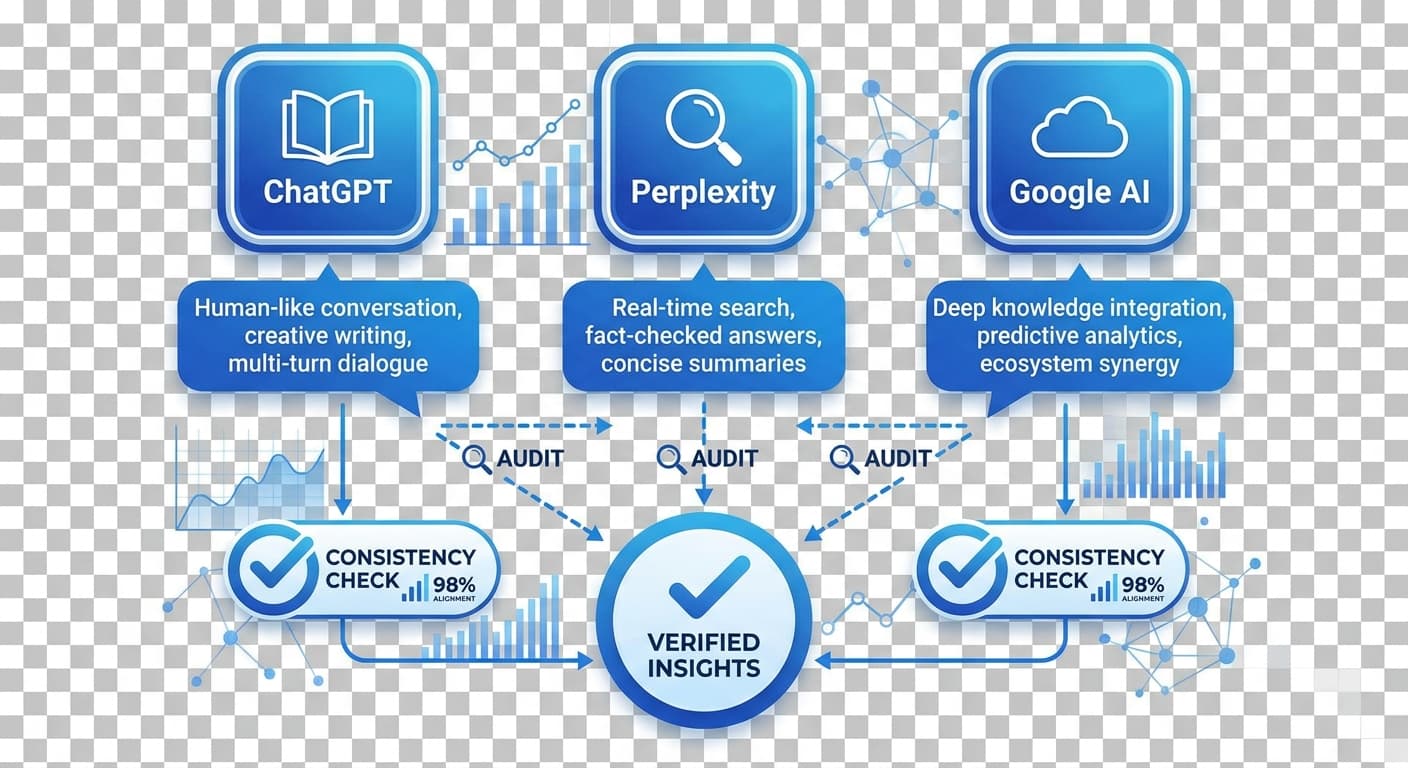
How to Build an AI Answer Consistency Audit Strategy When ChatGPT, Perplexity, and Google AI Overviews Return Conflicting Brand Claims
A striking 67% of commercial queries now return conflicting information about brands across ChatGPT, Perplexity, and Google AI Overviews—and that number is only growing as AI search continues its meteoric rise in 2025. With over 500 million weekly ChatGPT users and AI-powered search now accounting for 35% of all queries, brand inconsistency across AI platforms has become a critical business risk.
If your brand claims vary wildly between these platforms, you're not just losing potential customers—you're actively damaging trust and credibility. The solution? A systematic AI answer consistency audit strategy that identifies discrepancies and creates a unified brand narrative across all AI search engines.
Why AI Answer Consistency Matters More Than Ever in 2026
The AI search landscape has fundamentally shifted how consumers discover and evaluate brands. Unlike traditional search where users might visit multiple websites to compare information, AI engines provide definitive-sounding answers that users increasingly trust without further verification.
Recent studies show that 78% of Gen Z users accept AI search results as authoritative, making consistency across platforms crucial for maintaining brand integrity. When ChatGPT says your product has Feature A, but Perplexity claims it doesn't, potential customers face decision paralysis—or worse, they choose a competitor with more consistent messaging.
The Hidden Costs of Inconsistent AI Responses
Building Your AI Answer Consistency Audit Framework
Step 1: Identify Your Core Commercial Queries
Start by mapping the questions potential customers ask about your brand, products, or services. Focus on commercial intent queries that drive purchasing decisions:
Pro Tip: Use your existing search console data and customer support logs to identify the most frequent questions about your brand.
Step 2: Create Your Multi-Platform Testing Matrix
Systematically test each query across all major AI platforms:
Document responses in a standardized format that captures:
Step 3: Analyze Response Variations
Look for these common types of inconsistencies:
#### Factual Discrepancies
#### Tone and Positioning Variations
#### Completeness Gaps
Step 4: Map Inconsistencies to Source Content
For each discrepancy, trace back to potential source content:
This detective work reveals which content sources different AI engines prioritize and helps you understand why inconsistencies occur.
Developing Your Consistency Strategy
Prioritize High-Impact Fixes
Not all inconsistencies are equally important. Focus first on:
Create a Master Content Source
Develop authoritative content that serves as the single source of truth for each key topic. This content should be:
Platforms like Citescope Ai can help ensure your master content scores high on AI interpretability and semantic richness, making it more likely to be selected as the authoritative source by AI engines.
Implement Cross-Platform Content Synchronization
Once you've created authoritative content, ensure it's consistently represented across all platforms that AI engines might reference:
Advanced Audit Techniques
Temporal Consistency Testing
Test the same queries at different times to identify:
Contextual Variation Analysis
Test how slight query modifications affect responses:
Geographic and Demographic Testing
Where possible, test from different:
How Citescope Ai Helps Streamline Your Consistency Audit
Managing AI answer consistency manually across multiple platforms is time-intensive and error-prone. Citescope Ai's Citation Tracker continuously monitors when your content gets cited by ChatGPT, Perplexity, Claude, and Gemini, alerting you to inconsistencies as they emerge.
The platform's GEO Score analyzes your content across five dimensions crucial for AI visibility: interpretability, semantic richness, conversational relevance, structure, and authority. This helps ensure your authoritative content is more likely to be selected by AI engines, reducing inconsistency risks.
Measuring Success and Ongoing Optimization
Key Metrics to Track
Establishing Review Cycles
Implement regular audit cycles based on your business needs:
Building Internal Processes
Create workflows that prevent future inconsistencies:
Future-Proofing Your Strategy
As AI search continues evolving, stay ahead by:
Ready to Optimize for AI Search?
Building a comprehensive AI answer consistency audit strategy is complex, but the payoff is enormous. Brands with consistent AI presence see 40% higher conversion rates from AI-referred traffic and significantly stronger brand trust metrics.
Citescope Ai simplifies this process with automated citation tracking, content optimization recommendations, and comprehensive AI visibility analytics. Start with our free tier to audit your first three pieces of content, then scale with our Pro plan to monitor your entire brand presence across all major AI platforms.
Start your free AI consistency audit today →
Don't let inconsistent AI responses cost you customers. Take control of your brand's AI search presence with a systematic, data-driven approach that ensures your message remains consistent across every platform your customers use.