How to Build an AI Search Budget Reallocation Framework When 87% of Marketers Are Increasing Spend But Can't Justify ROI Without Traditional Click Data
How to Build an AI Search Budget Reallocation Framework When 87% of Marketers Are Increasing Spend But Can't Justify ROI Without Traditional Click Data
Here's a sobering reality check: 87% of marketers are pouring more budget into AI search optimization in 2026, but over 60% can't properly measure their return on investment. Why? Because we're still thinking in clicks when AI search engines like ChatGPT, Perplexity, Claude, and Gemini have fundamentally changed how consumers discover and consume information.
With AI search now representing 42% of all search queries and ChatGPT alone processing over 800 million queries weekly, the question isn't whether you should reallocate budget to AI search optimization—it's how to do it strategically without flying blind.
The Traditional ROI Measurement Crisis
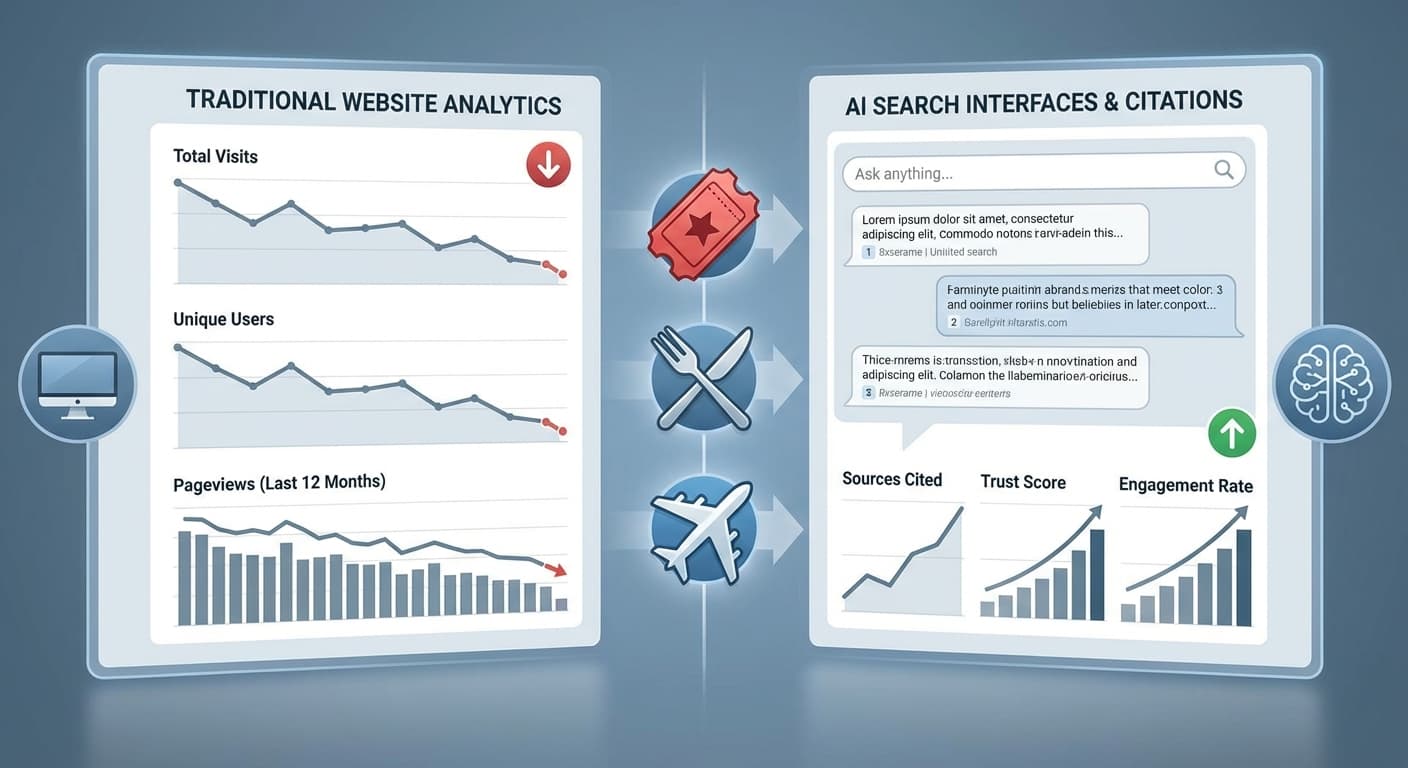
The problem runs deeper than most marketing leaders realize. Traditional SEO metrics—clicks, impressions, bounce rates—were built for a world where search meant clicking through to websites. But AI search engines provide direct answers, synthesizing information from multiple sources without requiring users to leave the platform.
Consider this: A potential customer asks Claude about "best project management software for remote teams" and receives a comprehensive answer citing your product. They never visit your website, but they purchase your solution three weeks later after remembering your brand from that AI-generated response. Traditional analytics miss this entirely.
The New Reality of Customer Journey Mapping
In 2026, the average B2B buyer interacts with AI search engines 7.3 times before making a purchase decision, according to recent Gartner research. Yet most marketing attribution models still rely on last-click attribution or first-touch metrics that completely ignore AI-powered touchpoints.
This creates a dangerous blind spot where marketing leaders see declining traditional search metrics and mistakenly conclude their content strategy isn't working, when in reality, their content might be performing exceptionally well in AI search results.
Building Your AI Search Budget Framework
Step 1: Audit Your Current AI Search Performance
Before reallocating a single dollar, you need baseline visibility into how your content currently performs in AI search results. This involves:
Step 2: Establish New KPIs Beyond Clicks
Successful AI search optimization requires entirely new metrics. Here's what forward-thinking marketers are tracking in 2026:
Primary Metrics:
Secondary Metrics:
Business Impact Metrics:
Step 3: Create Your Reallocation Strategy
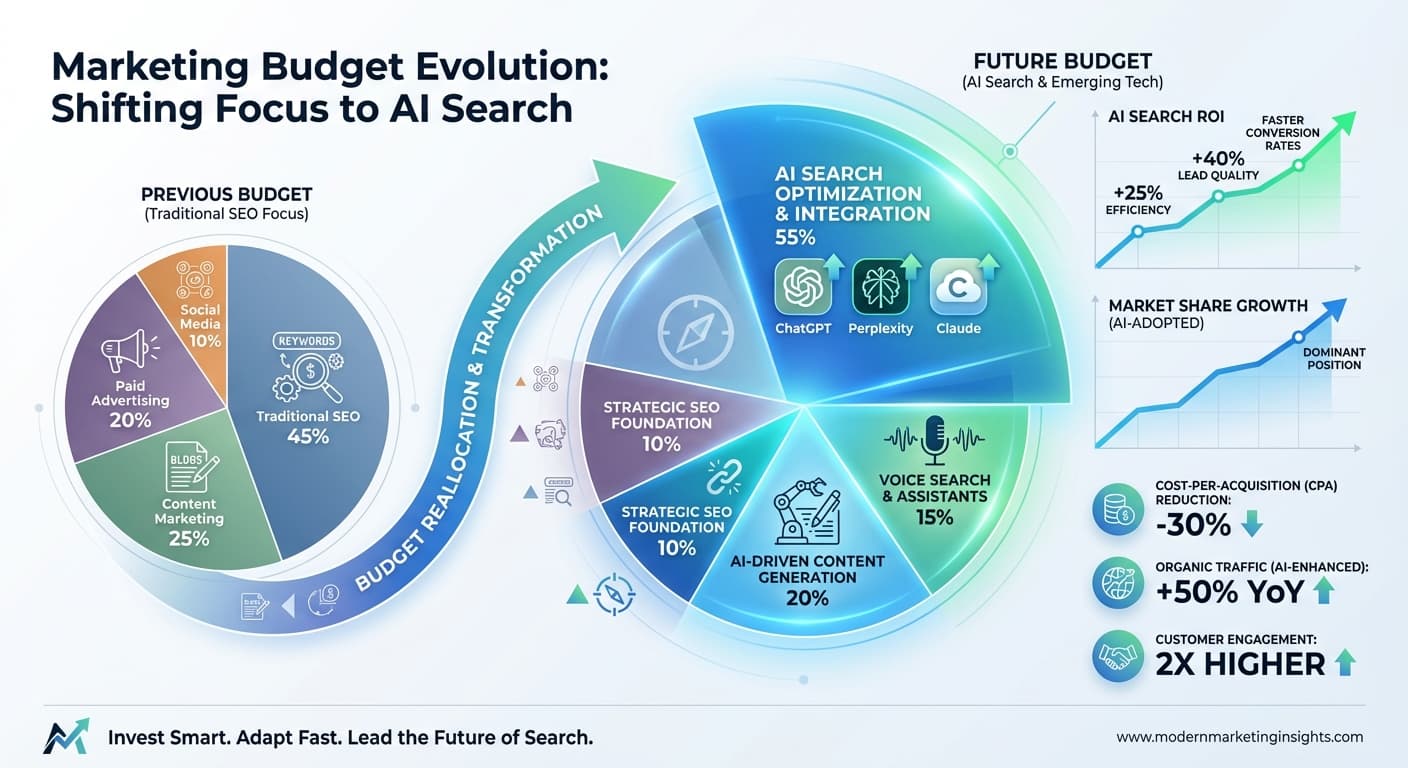
With baseline data and new KPIs established, you can now make informed budget decisions. Here's a proven framework:
The 70-20-10 AI Search Budget Model:
Budget Allocation by Channel:
Implementation Timeline and Resource Planning
Month 1-2: Foundation Building
Month 3-4: Content Optimization Phase
Month 5-6: Measurement and Iteration
Tools like Citescope Ai can accelerate this process significantly by providing GEO scores that analyze your content across five critical dimensions: AI Interpretability, Semantic Richness, Conversational Relevance, Structure, and Authority. This data-driven approach removes the guesswork from content optimization.
Measuring Success Without Traditional Click Data
Advanced Attribution Modeling for AI Search
The key to justifying AI search investment lies in sophisticated attribution modeling that accounts for the indirect nature of AI-powered discovery. Here's how leading companies are approaching this:
Brand Awareness Studies: Conduct quarterly surveys measuring unprompted brand awareness, specifically asking about AI-powered research experiences.
Sales Correlation Analysis: Track the relationship between AI citation frequency and sales pipeline velocity, even without direct attribution.
Customer Journey Mapping: Interview customers to understand how AI search influenced their decision-making process.
Competitive Share Analysis: Monitor your share of voice in AI responses compared to competitors over time.
Building Executive Buy-In
When presenting AI search ROI to leadership, focus on these compelling angles:
Common Pitfalls and How to Avoid Them
Pitfall 1: Abandoning Traditional SEO Too Quickly
AI search shouldn't replace traditional SEO—it should complement it. Maintain a balanced approach that optimizes for both human searchers and AI engines.
Pitfall 2: Focusing Only on Volume Metrics
A single high-quality citation from ChatGPT might be more valuable than 1,000 low-engagement website visits. Quality over quantity applies more than ever in AI search.
Pitfall 3: Ignoring Platform Differences
Each AI platform has unique preferences for content format, depth, and style. A one-size-fits-all approach will limit your success.
How Citescope Ai Helps
Building an effective AI search budget framework requires sophisticated measurement and optimization capabilities that most traditional SEO tools simply can't provide. Citescope Ai addresses this challenge with:
Comprehensive Citation Tracking: Monitor your content's performance across ChatGPT, Perplexity, Claude, and Gemini in real-time, giving you the visibility needed to justify budget allocation decisions.
GEO Score Analysis: Get objective, data-driven scores for your content's AI-readiness across five critical dimensions, eliminating guesswork from your optimization budget.
One-Click AI Optimization: Transform existing content with AI-powered rewriting that improves citation potential, maximizing ROI from your current content investments.
Multi-Format Export: Seamlessly integrate optimized content into your existing workflows with Markdown, HTML, and WordPress block exports.
Whether you're starting with the free tier (3 optimizations per month) or scaling with Pro ($39/month) or Enterprise ($99/month) plans, Citescope Ai provides the measurement framework essential for strategic budget reallocation.
Ready to Optimize for AI Search?
The shift to AI search isn't coming—it's here. While 87% of marketers are increasing their AI search spend, the winners will be those who can measure, optimize, and justify their investments with data-driven frameworks.
Start building your AI search budget framework today with Citescope Ai's free tier. Track citations, optimize content, and measure performance across all major AI platforms. Because in a world where traditional click data no longer tells the full story, you need tools built specifically for the AI search era.
Try Citescope Ai free today and transform your content strategy with confidence.