How to Build an AI Search Canopy Revenue Recovery Strategy When Enterprises Deploy Internal AI Assistants

How to Build an AI Search Canopy Revenue Recovery Strategy When Enterprises Deploy Internal AI Assistants
Enterprise AI assistants are quietly reshaping B2B revenue streams in ways most companies haven't fully grasped yet. By 2026, over 85% of Fortune 500 companies have deployed internal AI systems that answer employee questions using cached vendor data—without employees ever visiting your website or entering your sales funnel.
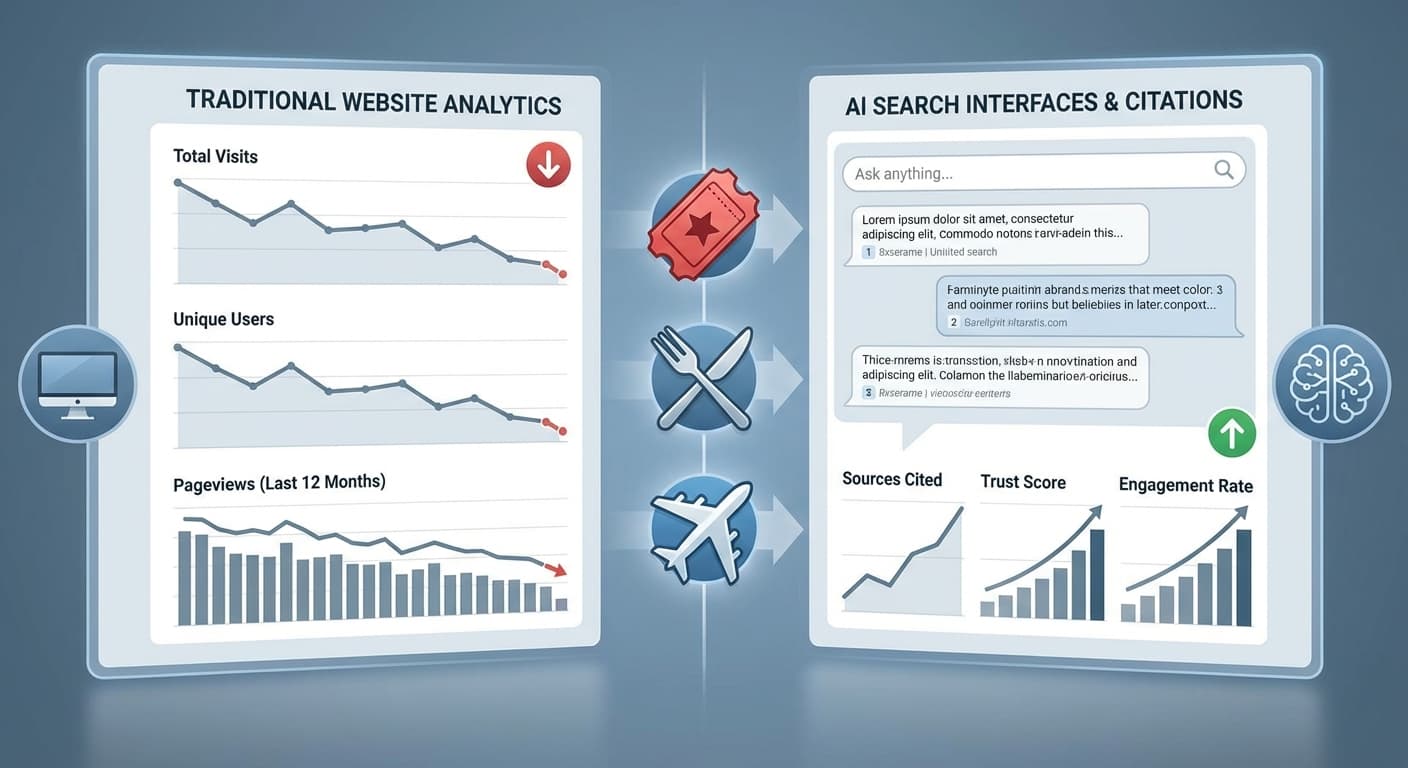
This invisible "AI search canopy" is intercepting millions of potential touchpoints, and traditional attribution models are blind to it. If your enterprise clients are using AI assistants that reference your content without generating trackable visits, you're facing a new challenge: how do you recover and optimize revenue when your expertise gets consumed through AI intermediaries?
Understanding the Enterprise AI Assistant Landscape
Enterprise AI assistants have evolved far beyond simple chatbots. Today's systems like Microsoft Copilot, Salesforce Einstein GPT, and custom LLM implementations are ingesting vast amounts of vendor content, documentation, and industry knowledge. When employees ask questions about solutions in your space, these AI systems often provide comprehensive answers sourced from your content—without attribution or click-through.
The Scope of the Problem
Recent industry data reveals the magnitude:
The Revenue Recovery Challenge
When enterprise AI assistants answer employee questions using your cached content, several revenue challenges emerge:
Lost Attribution
Traditional analytics can't track when your content influences decisions through internal AI systems. An employee might receive AI-generated recommendations based entirely on your thought leadership, but you'll never see that interaction.
Shortened Sales Cycles
AI assistants compress research phases, potentially eliminating multiple touchpoints where you'd normally capture leads or demonstrate value.
Commoditized Expertise
Your unique insights get blended into AI responses alongside competitor information, reducing differentiation.
Invisible Influence
Your content might be driving significant enterprise decisions without generating any measurable engagement signals.
Building Your AI Search Canopy Revenue Recovery Strategy
1. Map Your Content's AI Footprint
Start by understanding how your content appears in AI responses. This requires systematic tracking across multiple AI platforms that enterprises commonly use.
Action Steps:
2. Create AI-Optimized Attribution Signals
Since traditional tracking fails in AI environments, embed attribution signals directly into your content.
Strategies Include:
3. Develop AI Assistant Partnership Programs
Proactively engage with enterprise AI platform providers to ensure proper attribution and create new revenue channels.
Partnership Opportunities:
4. Implement Multi-Touch Attribution Models
Expand beyond last-click attribution to capture AI-influenced revenue.
Advanced Attribution Techniques:
Tactical Implementation Framework
Phase 1: Assessment and Mapping (Weeks 1-4)
Phase 2: Content Optimization (Weeks 5-12)
Phase 3: Revenue Recovery Systems (Weeks 13-24)
Measuring Success in the AI Canopy
Traditional metrics fall short when measuring AI-influenced revenue. Consider these alternative indicators:
Leading Indicators
Revenue Indicators
How Citescope Ai Helps Navigate the AI Canopy
While building an AI search canopy revenue recovery strategy requires multiple components, optimizing your content for AI visibility forms the foundation. Citescope Ai's GEO Score analyzes your content across five critical dimensions—AI Interpretability, Semantic Richness, Conversational Relevance, Structure, and Authority—giving you a clear roadmap for AI optimization.
The platform's Citation Tracker monitors when your content gets referenced by major AI systems including ChatGPT, Perplexity, Claude, and Gemini, providing the attribution visibility that traditional analytics miss. This data becomes crucial when building attribution models that account for AI-influenced revenue.
The AI Rewriter tool restructures your existing content for better AI interpretability, ensuring your expertise gets properly surfaced and attributed when enterprise AI assistants reference industry solutions.
Future-Proofing Your Strategy
As enterprise AI adoption accelerates, revenue recovery strategies must evolve continuously:
Emerging Trends to Watch
Strategic Recommendations
Ready to Optimize for AI Search?
The AI search canopy represents both a challenge and an opportunity. While traditional attribution becomes more complex, companies that proactively optimize for AI visibility and build recovery strategies will capture disproportionate value.
Citescope Ai helps you understand and optimize your content's performance across AI search engines, providing the foundation for any revenue recovery strategy. With our GEO Score analysis, Citation Tracker, and AI Rewriter, you can ensure your expertise gets properly surfaced and attributed in the AI-driven enterprise landscape.
Start with our free tier to analyze up to 3 pieces of content per month, or upgrade to Pro for comprehensive AI optimization across your entire content library. The AI canopy is growing—make sure your content is positioned to capture its value.
Try Citescope Ai free today and take the first step toward AI search revenue recovery.