GEO Strategy

How to Build an AI Search Temporal Relevance Strategy: Overcoming Legacy Citation Bias for Real-Time Content
June 13, 20267 min read
How to Build an AI Search Temporal Relevance Strategy: Overcoming Legacy Citation Bias for Real-Time Content

How to Build an AI Search Temporal Relevance Strategy: Overcoming Legacy Citation Bias for Real-Time Content

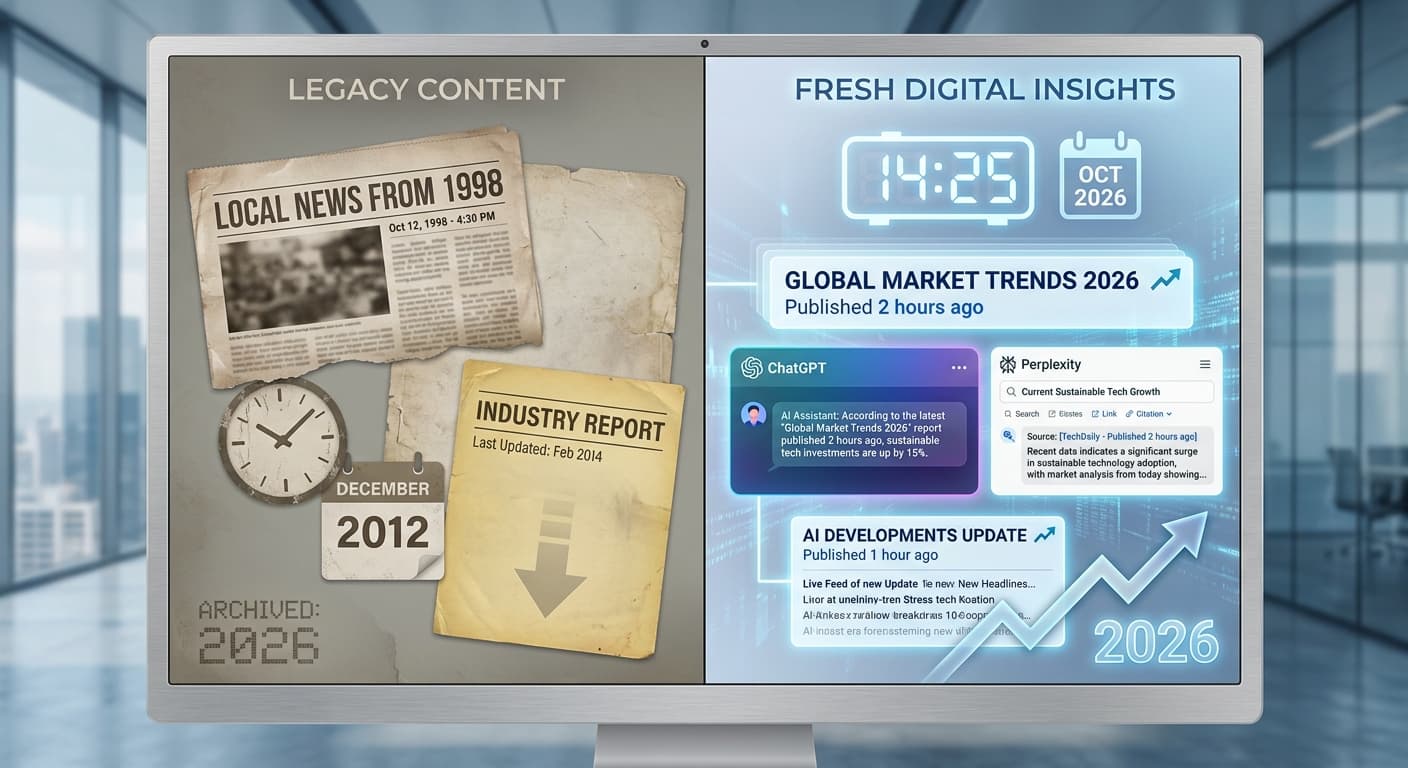
Picture this: You publish breaking news coverage within 2 hours of a major industry announcement, complete with expert analysis and fresh insights. Yet when someone asks ChatGPT or Perplexity about the event, they cite articles from 6 months ago instead of your timely, comprehensive piece. Sound familiar?

This isn't just frustrating—it's a fundamental challenge that's reshaping how we think about content strategy in 2026. With AI search now accounting for over 35% of all queries and ChatGPT alone serving 650M+ weekly users, understanding temporal relevance in AI citations has become mission-critical for content creators.

The AI Search Temporal Paradox

AI search engines face a unique challenge that traditional search doesn't: balancing authority with recency. While Google's algorithms have decades of refinement in temporal relevance signals, AI models often default to what they perceive as "established" sources—even when fresher, more accurate content exists.

Here's what's happening behind the scenes:

  • Training Data Lag: AI models are trained on historical data, creating an inherent bias toward older, well-established sources

  • Authority Weight: Established domains with high domain authority often outrank newer content, regardless of temporal relevance

  • Citation Momentum: Once an AI cites a source repeatedly, it creates a feedback loop that reinforces that citation pattern
  • The Real Cost of Legacy Citation Bias

    Recent studies from 2025 show that 72% of real-time event queries in AI search engines cite sources that are at least 30 days old, despite fresh content being available. This creates several problems:

  • News publishers lose traffic to outdated articles

  • Audiences receive stale information during rapidly evolving situations

  • Content creators struggle to establish authority in their niches

  • Breaking news and trend coverage becomes less valuable
  • Understanding AI Temporal Ranking Factors

    To build an effective temporal relevance strategy, you need to understand how AI engines evaluate time-sensitive content. Unlike traditional SEO, AI search considers these unique factors:

    1. Content Freshness Signals

  • Publication timestamps (must be clearly marked and recent)

  • Update indicators (last modified dates, revision notes)

  • Real-time references ("as of today," "latest developments," "breaking")

  • Temporal keywords ("2026 update," "current status," "recent changes")
  • 2. Source Velocity Indicators

  • How quickly your domain publishes content about trending topics

  • Your historical accuracy with time-sensitive information

  • Consistency in covering evolving stories

  • Speed of corrections and updates when new information emerges
  • 3. Contextual Relevance Markers

  • Direct quotes from recent events or announcements

  • References to current market conditions or statistics

  • Links to official sources and primary documents

  • Integration of real-time data and metrics
  • Building Your AI Search Temporal Relevance Strategy

    Phase 1: Infrastructure Setup

    Optimize Your Publishing Pipeline

  • Implement rapid publishing workflows that allow content creation within 30-60 minutes of breaking news

  • Use structured data markup to clearly indicate publication and update times

  • Create template systems for common types of breaking news or trend coverage

  • Establish monitoring systems to track when events relevant to your niche occur
  • Technical Optimizations

  • Ensure your CMS automatically generates accurate timestamps

  • Use schema markup for NewsArticle and datePublished fields

  • Implement automatic social media and RSS feed updates

  • Create dedicated landing pages for trending topics
  • Phase 2: Content Strategy Refinement

    The "Layered Freshness" Approach

    Instead of just publishing once, create a content ecosystem around time-sensitive topics:

  • Breaking Coverage (0-2 hours): Initial announcement with basic facts

  • Analysis Layer (2-6 hours): Expert commentary and implications

  • Deep Dive (6-24 hours): Comprehensive analysis with data and predictions

  • Follow-up Updates (ongoing): Track developments and update accordingly
  • Temporal Content Optimization Techniques

  • Lead with time-specific language: "January 2026 Update," "Latest Developments in..."

  • Include current statistics: Always cite the most recent data available

  • Reference concurrent events: Connect your topic to other current happenings

  • Use progressive verb tenses: "Companies are adopting..." vs. "Companies adopted..."
  • Phase 3: Authority Building for Fresh Content

    Since AI engines heavily weight authority, you need strategies to establish credibility quickly:

    Rapid Authority Signals

  • Quote primary sources directly and extensively

  • Link to official announcements and press releases

  • Include expert interviews conducted specifically for your coverage

  • Cite recent academic research or industry reports

  • Cross-reference multiple current sources to show comprehensiveness
  • Social Proof Acceleration

  • Share content immediately across social platforms

  • Engage with industry experts to generate discussion

  • Submit to news aggregators and industry publications

  • Create multimedia content (videos, infographics) for broader reach
  • Advanced Tactics for AI Citation Priority

    The "Citation Velocity" Strategy

    AI engines notice when multiple recent sources cite your content. Here's how to accelerate this:

  • Create quotable soundbites that other publishers will reference

  • Develop unique data points or exclusive insights

  • Build relationships with other publishers in your space

  • Offer expert commentary to journalists covering the same story
  • Semantic Clustering for Temporal Relevance

    Group related fresh content to create topical authority:

  • Create content series around evolving stories

  • Use consistent tagging and internal linking

  • Build topic clusters that demonstrate ongoing coverage

  • Develop specialized landing pages for breaking news categories
  • The "Update Cascade" Method

    Instead of publishing entirely new articles, strategically update existing high-authority content:

  • Add "2026 Update" sections to evergreen content

  • Refresh statistics and examples regularly

  • Include "as of [current date]" language throughout

  • Create update logs showing when content was refreshed
  • Measuring Temporal Relevance Success

    Track these key metrics to optimize your strategy:

    AI Citation Metrics

  • Speed to first AI citation (target: under 24 hours)

  • Citation frequency for breaking news content

  • Temporal keyword rankings in AI responses

  • Share of voice for trending topics
  • Engagement Indicators

  • Time-to-traffic (how quickly content gains traction)

  • Social sharing velocity

  • Expert engagement and quotes

  • Media pickup and syndication
  • How Citescope Ai Helps

    Building an effective temporal relevance strategy requires constant optimization and monitoring. Citescope Ai's platform provides essential tools for time-sensitive content success:

    Real-Time Citation Tracking: Monitor when your fresh content gets cited by ChatGPT, Perplexity, Claude, and Gemini, allowing you to see which temporal strategies work fastest.

    GEO Score Analysis: Our 5-dimension scoring system helps you optimize content structure, semantic richness, and authority signals specifically for breaking news and trending topics.

    AI Rewriter for Temporal Content: One-click optimization that restructures your content to include stronger temporal relevance signals and current context markers.

    Overcoming Common Temporal Relevance Challenges

    Challenge 1: "My Fresh Content Never Gets Cited"

    Solutions:

  • Improve your content's AI Interpretability score

  • Include more specific timestamps and current references

  • Build stronger topical authority through consistent coverage

  • Optimize for conversational queries about current events
  • Challenge 2: "AI Engines Keep Citing My Outdated Articles"

    Solutions:

  • Update old content with current information

  • Create redirect strategies for outdated pieces

  • Publish comprehensive "current state" articles that supersede old content

  • Use canonical tags to prioritize your freshest coverage
  • Challenge 3: "Breaking News Traffic Doesn't Convert"

    Solutions:

  • Create content funnels from breaking news to evergreen resources

  • Include relevant product mentions in time-sensitive content

  • Build email capture strategies around trending topics

  • Develop retargeting campaigns for breaking news visitors
  • The Future of Temporal Relevance in AI Search

    As we move deeper into 2026, expect these developments:

  • Improved real-time indexing as AI models become more sophisticated

  • Greater emphasis on source recency in citation algorithms

  • Enhanced temporal understanding in conversational AI responses

  • Better integration between breaking news and AI search results
  • Ready to Optimize for AI Search?

    Building an effective temporal relevance strategy requires the right tools and insights. Citescope Ai helps content creators track citations, optimize for AI visibility, and measure success across ChatGPT, Perplexity, Claude, and Gemini.

    Start with our free tier (3 optimizations per month) to see how your time-sensitive content performs in AI search engines. Upgrade to Pro ($39/month) for unlimited optimizations and real-time citation tracking, or choose Enterprise ($99/month) for advanced analytics and team collaboration features.

    Ready to get your fresh content cited by AI engines? Start your free Citescope Ai trial today and transform your temporal relevance strategy.

    AI Search OptimizationTemporal RelevanceContent StrategyReal-time SEOAI Citations

    Track your AI visibility

    See how your content appears across ChatGPT, Perplexity, Claude, and more.

    Start for Free