How to Optimize Content for Multi-Platform AI Query Complexity: From 3-Word Google Searches to 21-Word ChatGPT Questions
How to Optimize Content for Multi-Platform AI Query Complexity: From 3-Word Google Searches to 21-Word ChatGPT Questions
By 2026, content creators face an unprecedented challenge: while traditional SEO taught us to optimize for concise "pizza near me" searches, AI platforms now process complex, conversational queries like "What are the best pizza restaurants within 15 minutes of downtown that offer gluten-free options and have outdoor seating for a romantic dinner?" With AI search now accounting for 35% of all queries and ChatGPT handling over 600 million weekly users, your content strategy needs a complete overhaul.
The disconnect is striking. Most content strategies still revolve around 2-4 word keywords, yet AI engines excel at understanding and responding to nuanced, multi-faceted questions that mirror natural human conversation. This shift represents the biggest change in search behavior since Google's inception.
The Evolution of Query Complexity
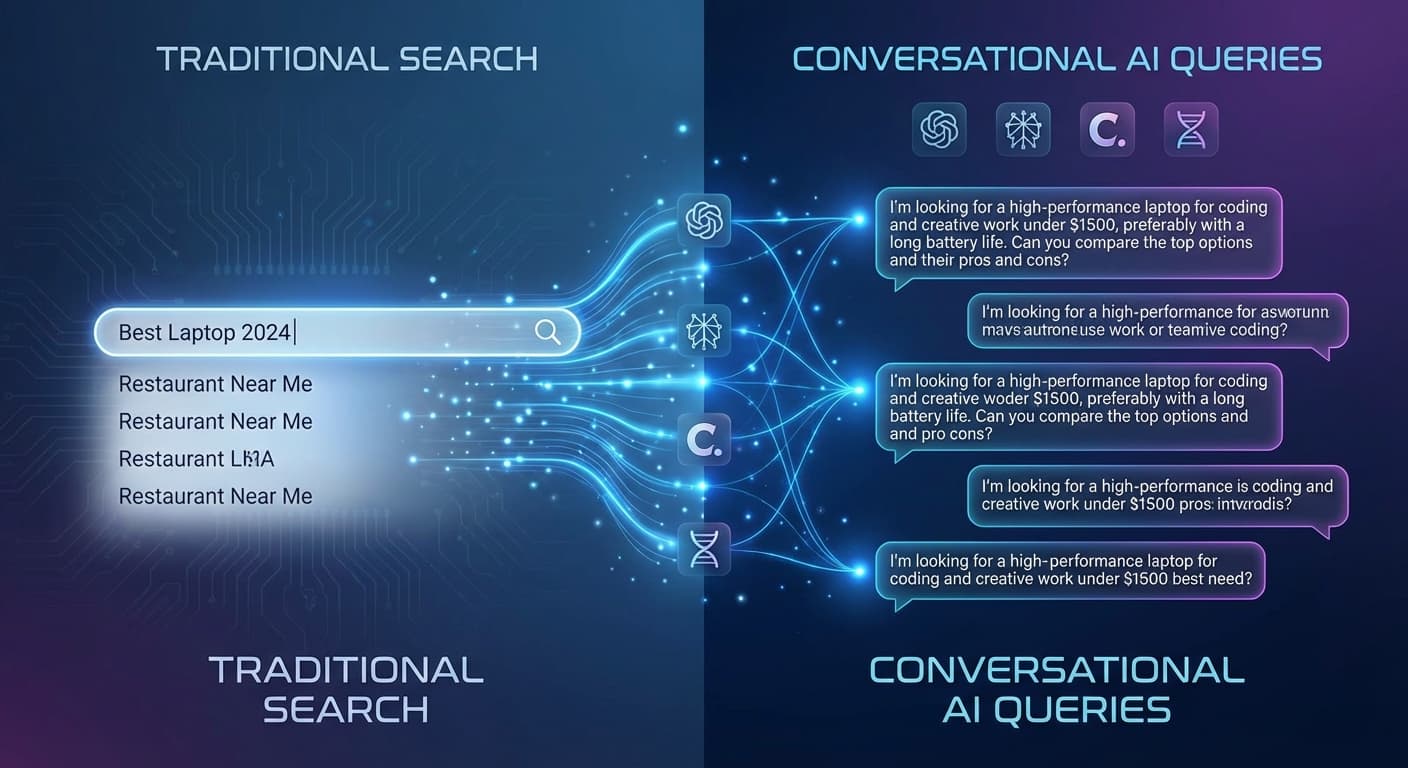
Traditional search engines trained us to think in fragments. We learned to type "best laptop 2026" instead of asking "What's the best laptop for a graphic designer who works primarily with video editing and needs excellent color accuracy?"
AI search platforms have reversed this trend entirely:
This isn't just about length—it's about intent sophistication. AI users ask follow-up questions, provide context, and expect comprehensive answers that address multiple angles of their inquiry.
Why Traditional SEO Falls Short in AI Search
Your current keyword-focused strategy likely misses AI search opportunities because:
1. Context Over Keywords
AI engines prioritize semantic understanding over exact keyword matches. A page optimized for "social media marketing tips" might miss traffic from users asking "How can a small business owner with limited time create an effective social media presence that actually drives sales?"
2. Conversational Intent
AI users expect dialogue, not document retrieval. They ask questions like humans would ask experts, complete with qualifiers, constraints, and follow-up considerations.
3. Multi-Topic Queries
Modern AI queries often span multiple topics. Users might ask: "What are the tax implications of starting a dropshipping business in California while working a full-time job, and what legal structure would be best?" This crosses tax law, business formation, employment law, and e-commerce.
The Four Pillars of Multi-Platform Query Optimization
1. Long-Form Conversational Content
Instead of targeting individual keywords, create comprehensive content that addresses the full spectrum of related questions. For example:
Traditional approach: Target "email marketing ROI"
AI-optimized approach: Create content answering "How do I calculate email marketing ROI, what metrics should I track, which tools provide the best analytics, and how do I improve performance based on the data?"
Structure your content to answer both simple and complex variations:
2. Semantic Topic Clustering
Group related concepts naturally within your content. AI engines excel at understanding relationships between topics, so your content should reflect these connections.
For a piece on "content marketing," naturally incorporate:
3. Question-Answer Architecture
Structure content to directly address the questions AI users ask:
Example structure:
What Makes Email Subject Lines Effective?
[Direct answer]
How Do You Test Subject Line Performance?
[Practical steps]
What Are the Most Common Subject Line Mistakes?
[List with explanations]
4. Multi-Format Information Delivery
AI engines pull information from various content formats within a single piece:
Platform-Specific Optimization Strategies
ChatGPT Optimization
ChatGPT favors:
Perplexity Optimization
Perplexity prioritizes:
Claude Optimization
Claude responds well to:
Gemini Optimization
Gemini excels with:
Measuring Multi-Platform Success
Traditional SEO metrics don't tell the full story for AI optimization. Track:
AI Citation Metrics
Content Performance Indicators
Common Optimization Mistakes to Avoid
1. Keyword Stuffing for AI
Don't simply repeat long-tail keywords. AI engines recognize and penalize unnatural language patterns.
2. Ignoring Platform Differences
Each AI platform has unique preferences. Content optimized only for ChatGPT might underperform on Perplexity.
3. Neglecting Follow-Up Questions
Users often ask related questions after initial queries. Your content should anticipate and address these natural progressions.
4. Over-Optimizing for Length
Longer isn't always better. AI engines value comprehensive, relevant information over word count.
How Citescope Ai Helps
Optimizing for multiple AI platforms simultaneously requires sophisticated analysis and tracking. Citescope Ai's GEO Score evaluates your content across five critical dimensions:
The platform's AI Rewriter then optimizes your content with one click, restructuring it for maximum visibility across ChatGPT, Perplexity, Claude, and Gemini. The Citation Tracker monitors your success, showing exactly when and how your content gets cited across platforms.
Building Your Multi-Platform Strategy
Phase 1: Audit Current Content
Phase 2: Restructure High-Priority Content
Phase 3: Create AI-First Content
Phase 4: Monitor and Optimize
The Future of Search Optimization
As AI search continues evolving, successful content creators will need to balance multiple optimization approaches:
The brands and creators who adapt quickly to this multi-platform reality will capture the growing AI search market while maintaining their traditional search presence.
Ready to Optimize for AI Search?
The shift from fragment-based keywords to complex, conversational queries represents the future of search. While traditional SEO remains important, AI optimization is now essential for comprehensive digital visibility.
Citescope Ai makes this transition seamless with its comprehensive suite of AI optimization tools. Start with our free tier—3 optimizations per month—to see how your content performs across multiple AI platforms. Ready to scale? Our Pro plan ($39/month) provides unlimited optimizations and advanced citation tracking.
Start optimizing your content for AI search today with Citescope Ai's free trial.