How to Optimize Your Business for Voice Assistant Discovery When AI Search Bypasses Traditional SEO

How to Optimize Your Business for Voice Assistant Discovery When AI Search Bypasses Traditional SEO
When a customer asks Siri "Find me a good Italian restaurant nearby" or tells Perplexity "I need a reliable plumber in downtown Seattle," traditional SEO rankings become almost irrelevant. These AI-powered queries now represent over 40% of all local business searches in 2026, yet most businesses are still optimizing for yesterday's search landscape.
The shift is dramatic: voice assistants and AI search engines like Perplexity, ChatGPT, and Gemini are fundamentally changing how customers discover local businesses. They're not simply reading from Google's top 10 results anymore—they're synthesizing information from multiple sources, prioritizing conversational relevance, and making recommendations based on context that traditional SEO signals can't capture.
The New Reality of AI-Powered Local Discovery
In 2026, we're witnessing a seismic shift in how people find local businesses. Consider these eye-opening statistics:
What makes this shift so challenging for businesses is that AI engines don't rely solely on traditional ranking factors like backlinks, domain authority, or keyword density. Instead, they evaluate content through what's called Generative Engine Optimization (GEO)—a completely different set of criteria focused on how well your content can be understood, synthesized, and recommended by AI.
Understanding How AI Assistants Process Local Business Information
When someone asks Perplexity "What's the best coffee shop for remote work in Brooklyn?" or tells Alexa "Find me a dentist that takes my insurance," these AI systems are performing complex analysis that goes far beyond traditional keyword matching.
The Five Dimensions AI Engines Evaluate
1. AI Interpretability
Can the AI easily understand what your business does, who it serves, and what makes it unique? This isn't about keyword stuffing—it's about clear, contextual information that helps AI engines grasp your business's essence.
2. Semantic Richness
How well does your content connect related concepts? AI engines look for natural language patterns and semantic relationships that help them understand the full context of your business.
3. Conversational Relevance
Does your content answer the types of questions real people ask in natural conversation? "Do you take walk-ins?" "What's your cancellation policy?" "Are you good for families?"
4. Structured Information
While AI can parse unstructured text, clearly organized information with proper headings, lists, and logical flow dramatically improves your chances of being cited.
5. Authority Signals
This includes traditional factors like reviews and citations, but also newer signals like consistency across platforms and the depth of information provided.
Strategies for Voice Assistant Optimization
1. Create Conversational Content That Answers Real Questions
Traditional SEO focuses on keywords, but voice assistant optimization requires thinking about complete questions and natural dialogue.
Instead of optimizing for: "dentist Brooklyn emergency"
Optimize for: "I have a severe toothache and need an emergency dentist in Brooklyn tonight. Do you accept walk-ins and work with Delta insurance?"
Actionable Steps:
2. Implement Structured Data Beyond Traditional Schema
While schema markup remains important, AI engines are increasingly looking for structured information that goes beyond basic NAP (Name, Address, Phone) data.
Essential Information to Structure:
3. Optimize for Context and Intent, Not Just Keywords
AI assistants excel at understanding context and user intent. Your content needs to match not just what people are searching for, but why they're searching and what they need to know to make a decision.
Example Context Optimization:
Traditional approach: "Best Italian restaurant Brooklyn"
AI-optimized approach: "Looking for an authentic Italian restaurant in Brooklyn perfect for a romantic anniversary dinner? Our intimate 20-seat trattoria features handmade pasta, an extensive Italian wine list, and private corner tables. We're open until 11 PM Tuesday through Saturday and accept reservations up to 30 days in advance."
4. Create Location-Specific, Hyperlocal Content
AI engines are remarkably good at understanding geographic context and local nuances. Generic content won't cut it—you need hyperlocal relevance.
Hyperlocal Content Strategies:
5. Build Authority Through Comprehensive Information Architecture
AI engines favor businesses that provide complete, authoritative information. This means going beyond basic listings to create comprehensive resource hubs.
Authority-Building Elements:
Platform-Specific Optimization Strategies
Perplexity Optimization
Perplexity excels at synthesizing information from multiple sources. To optimize for Perplexity:
Voice Assistant Integration
For Siri, Alexa, and Google Assistant:
ChatGPT and AI Search Integration
For broader AI search visibility:
How Citescope Ai Helps
Optimizing for AI-powered local discovery requires a fundamentally different approach than traditional SEO, and that's where specialized tools become invaluable. Citescope Ai's GEO Score analyzes your content across all five dimensions that AI engines evaluate—AI Interpretability, Semantic Richness, Conversational Relevance, Structure, and Authority—giving you a clear 0-100 score that shows exactly how well your content will perform in AI search.
The platform's AI Rewriter can transform your existing business content with one click, restructuring it for maximum visibility in voice assistants and AI search engines. Plus, the Citation Tracker lets you monitor when your business gets mentioned by ChatGPT, Perplexity, Claude, and Gemini, so you can see the real impact of your optimization efforts.
Measuring Success in the AI Era
New Metrics to Track
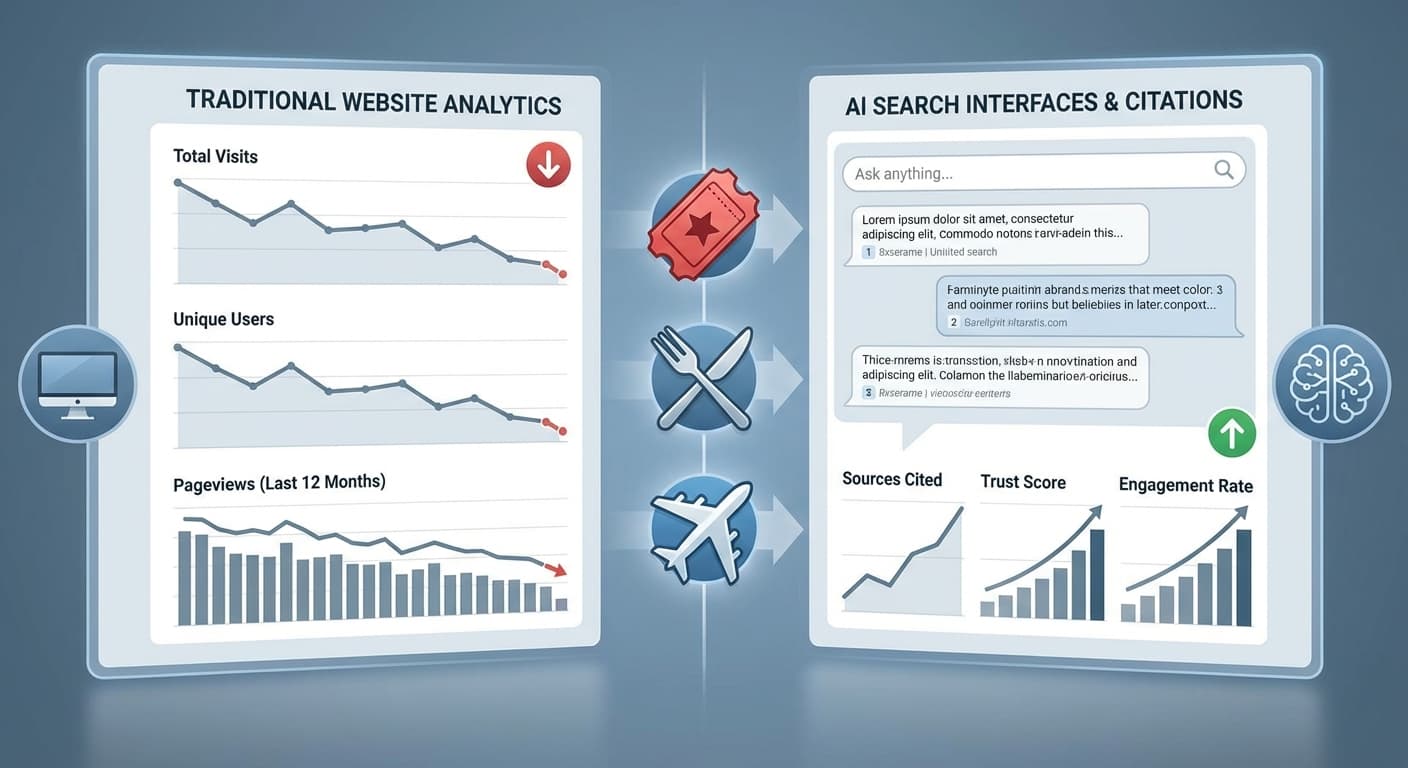
Traditional SEO metrics won't tell the full story of your AI search performance. Focus on:
Tools and Technologies
Beyond Google Analytics, consider:
Future-Proofing Your Local SEO Strategy
The landscape will continue evolving rapidly. Businesses that thrive will be those that:
Ready to Optimize for AI Search?
The shift to AI-powered local discovery isn't coming—it's already here. While your competitors are still optimizing for traditional search rankings, you can get ahead by focusing on what AI engines actually value: clear, conversational, comprehensive content that genuinely helps customers make informed decisions.
Citescope Ai makes this transition straightforward with tools specifically designed for the AI search era. Start with our free tier to analyze and optimize up to 3 pieces of content per month, or upgrade to Pro for $39/month to transform your entire digital presence for AI visibility. Ready to see how your content performs in the age of AI search? Try Citescope Ai today and discover what you've been missing.