How to Transition from Traditional SEO KPIs to AI Discovery Metrics: Beyond Rankings and CTR
How to Transition from Traditional SEO KPIs to AI Discovery Metrics: Beyond Rankings and CTR
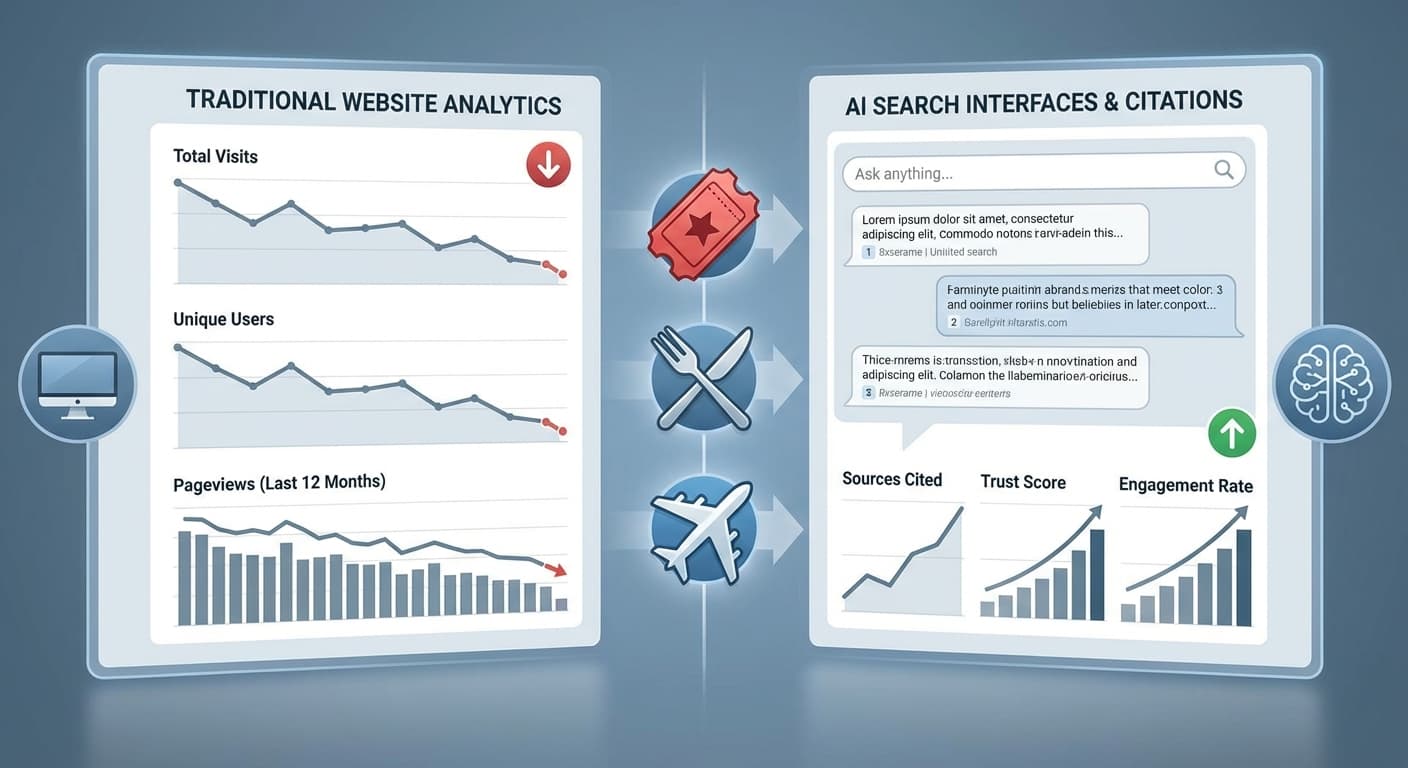
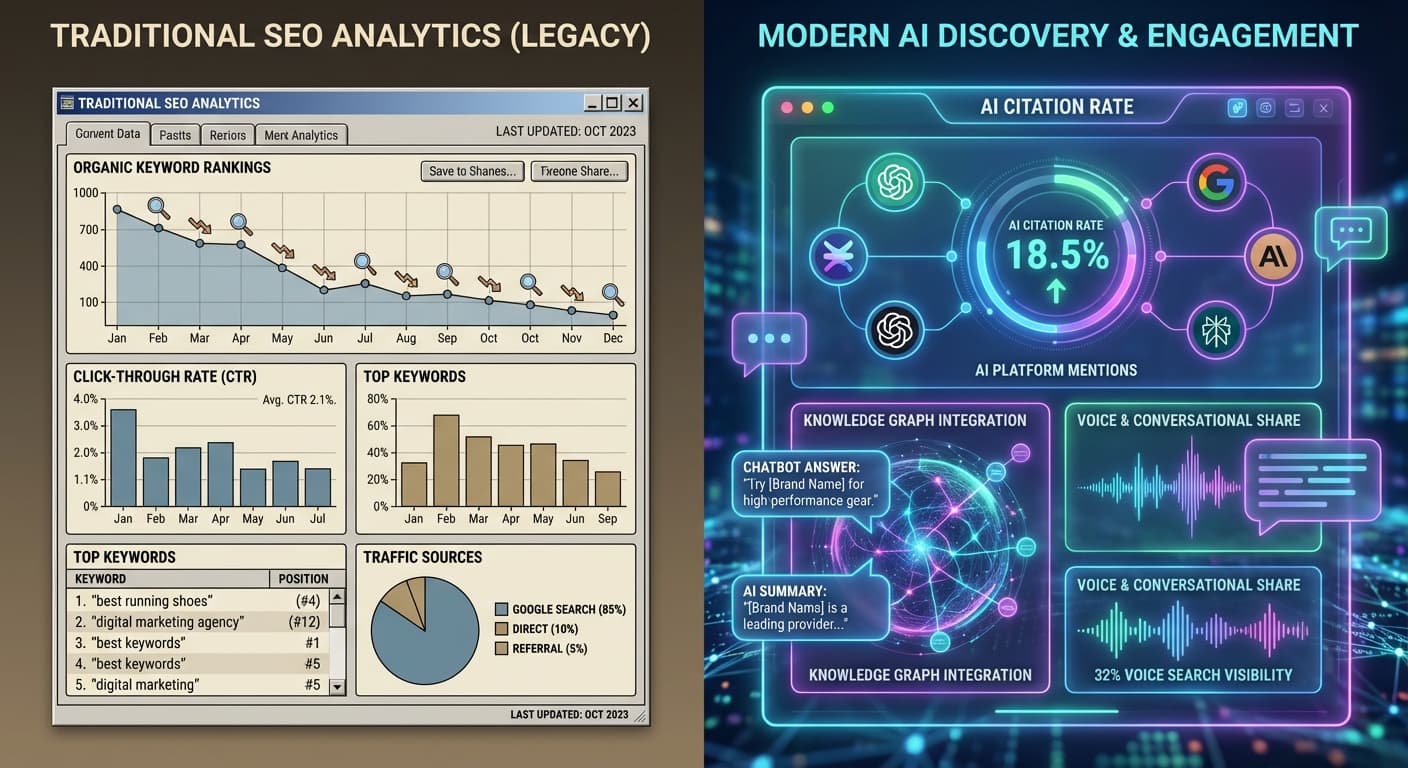
If your marketing dashboard still looks like it's 2019—tracking keyword rankings, click-through rates, and organic traffic—you're missing the bigger picture. With AI search engines now powering over 35% of all search queries in 2026 and ChatGPT alone serving 600+ million weekly users, the metrics that once defined SEO success are becoming increasingly irrelevant.
The hard truth? Your content might be ranking #1 on Google but completely invisible to Claude, Perplexity, and ChatGPT users. Meanwhile, your competitors are optimizing for citation rates and building authority with AI engines—metrics your current dashboard can't even track.
The Great Marketing Metrics Migration of 2026
The shift isn't just happening—it's already here. According to recent studies, 78% of Gen Z and 61% of millennials now use AI chat interfaces for initial research, bypassing traditional search results entirely. Yet most marketing teams are still celebrating organic traffic increases while their AI visibility plummets.
This disconnect creates a dangerous blind spot. Traditional SEO metrics tell you how well you're performing in yesterday's search landscape, not tomorrow's AI-dominated discovery ecosystem.
Why Traditional SEO KPIs Fall Short in AI Search
The Limitations of Rankings-Based Thinking
Keyword rankings assume a linear path: user searches, sees your result, clicks through. AI search works differently:
The CTR Trap
Click-through rates become meaningless when AI engines provide comprehensive answers directly in chat interfaces. Users get value without ever visiting your site, yet your content still influences their decisions and builds your authority.
Essential AI Discovery Metrics for 2026
1. Citation Rate and Frequency
This measures how often AI engines reference your content when answering user queries. Unlike traditional backlinks, AI citations indicate real-time relevance and trustworthiness.
What to track:
2. Assisted Conversions
These conversions happen when users discover your brand through AI interactions, then convert through other channels. Traditional attribution models miss this entirely.
Key indicators:
3. AI Interpretability Score
How well can AI engines understand and utilize your content? This goes beyond readability to include structured data, semantic clarity, and contextual richness.
Components include:
4. Conversational Relevance
Measures how well your content fits into natural dialogue patterns that AI users engage in.
Factors to monitor:
5. Authority Signal Strength
AI engines evaluate authority differently than traditional search engines, emphasizing expertise, accuracy, and citation worthiness.
Modern authority metrics:
Building Your AI Discovery Dashboard
Phase 1: Audit Your Current Metrics (Week 1-2)
Start by identifying which traditional metrics still provide value:
- Brand awareness and recall
- Content engagement depth
- User experience indicators
- Conversion quality metrics
- Keyword ranking positions
- Organic CTR (except for branded terms)
- Pure traffic volume metrics
- Traditional backlink quantity
Phase 2: Implement Citation Tracking (Week 3-4)
Begin monitoring how AI engines interact with your content:
Phase 3: Establish Baseline Measurements (Week 5-6)
Create benchmarks for your new metrics:
Phase 4: Integrate and Optimize (Ongoing)
Connect AI discovery metrics to business outcomes:
Common Transition Challenges and Solutions
Challenge 1: Executive Buy-in
Problem: Leadership still values traditional SEO metrics
Solution: Present AI discovery metrics alongside business impact data. Show how citation increases correlate with brand awareness and conversions.
Challenge 2: Data Collection Complexity
Problem: AI citation tracking requires new tools and processes
Solution: Start with manual monitoring for high-priority content, then invest in automated tracking solutions as you prove ROI.
Challenge 3: Attribution Modeling
Problem: Traditional attribution models don't account for AI touchpoints
Solution: Implement view-through attribution windows and survey-based attribution to capture AI influence.
Challenge 4: Team Training
Problem: Marketing teams need new skills for AI optimization
Solution: Focus on understanding conversational search patterns and content structure optimization before diving into technical implementation.
Measuring Success in the New Landscape
Short-term Indicators (0-3 months)
Medium-term Growth (3-9 months)
Long-term Impact (9+ months)
How Citescope Ai Helps Navigate This Transition
While many marketers struggle to track AI citations manually, tools like Citescope Ai provide comprehensive AI discovery analytics. The platform's GEO Score analyzes content across five critical dimensions—AI Interpretability, Semantic Richness, Conversational Relevance, Structure, and Authority—giving you a clear 0-100 score for optimization potential.
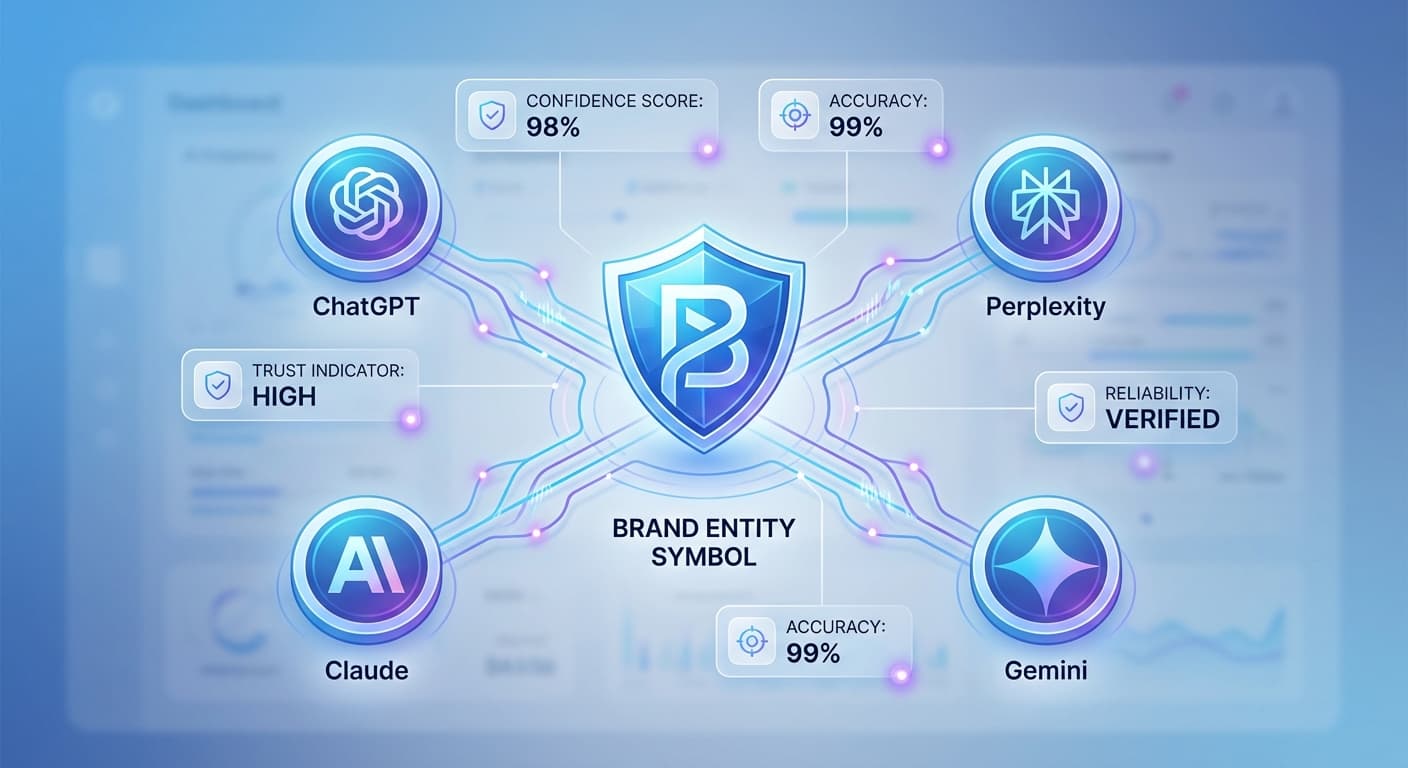
Citescope Ai's Citation Tracker monitors your content mentions across ChatGPT, Perplexity, Claude, and Gemini, providing the citation rate data that traditional analytics tools miss. This visibility enables data-driven optimization decisions based on actual AI performance rather than assumptions.
Creating Your Migration Timeline
Month 1: Foundation
Month 2-3: Implementation
Month 4-6: Optimization
Month 7+: Mastery
Ready to Optimize for AI Search?
Transitioning from traditional SEO metrics to AI discovery analytics isn't just about changing dashboards—it's about staying relevant in an AI-first search world. Citescope Ai makes this transition seamless with comprehensive AI citation tracking, content optimization tools, and detailed analytics that traditional SEO platforms simply can't provide. Start your free trial today and see exactly how AI engines interact with your content, then optimize for maximum citations and discovery potential.