Why 87% of Small Businesses Will Lose Customers Without AI Search Optimization in 2026

Why 87% of Small Businesses Will Lose Customers Without AI Search Optimization in 2026
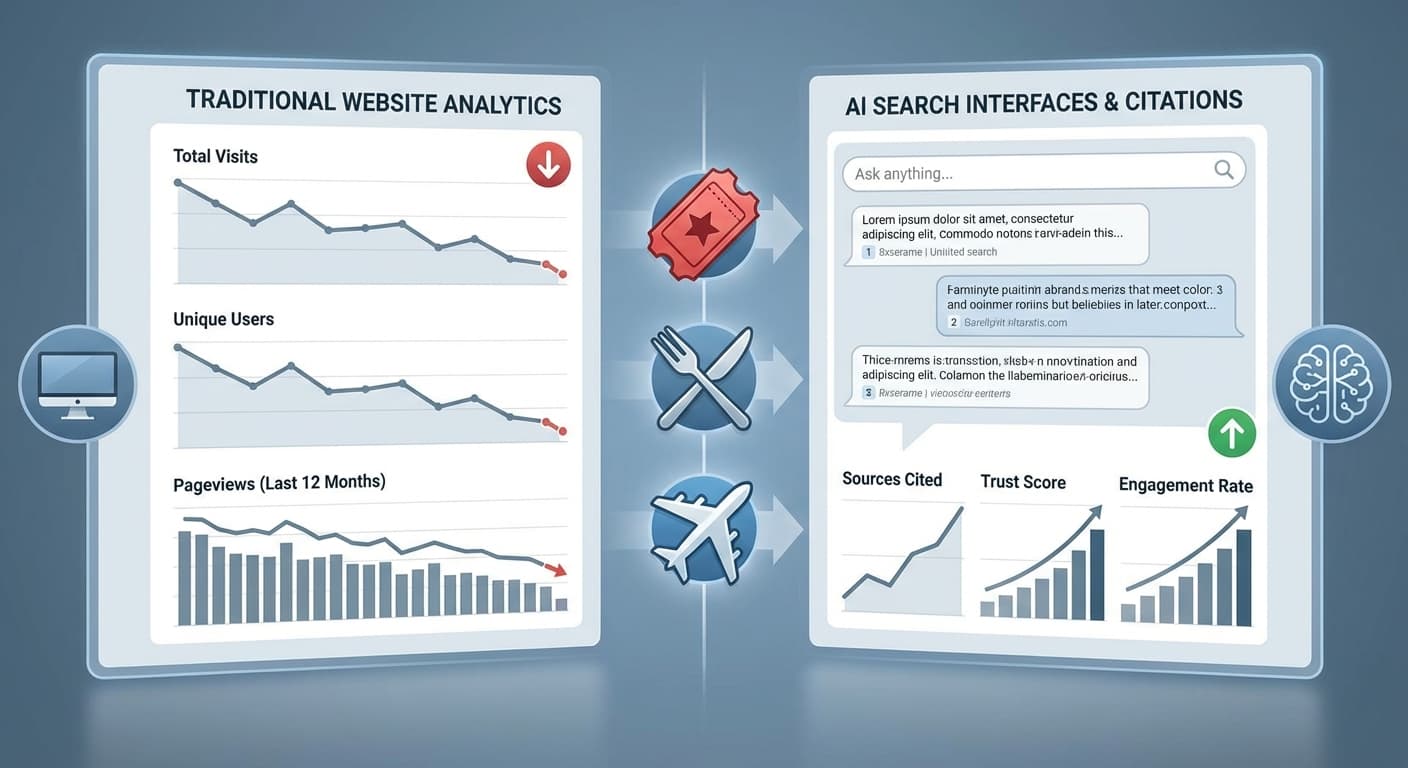
Here's a stat that should wake up every small business owner: 87% of small businesses are expected to lose significant customer acquisition opportunities in 2026 due to their absence from AI search results. With AI-powered search engines now handling over 35% of all online queries and ChatGPT alone serving 600+ million weekly users, the writing is on the wall.
If your small business isn't optimized for AI search engines like ChatGPT, Perplexity, Claude, and Gemini, you're essentially invisible to a rapidly growing segment of potential customers. Let's dive into why this matters now and what you can do about it.
The 2026 AI Search Revolution: What Small Businesses Need to Know
The landscape of online discovery has fundamentally shifted. While traditional Google searches still dominate, AI search engines have captured 35% of query volume in 2026, up from just 8% in early 2024. This isn't just a tech trend—it's a customer behavior revolution.
The New Customer Journey
Today's customers, especially Gen Z (who make up 73% of AI search users), follow a dramatically different path to purchase:
How AI Search Engines Are Changing Customer Discovery Patterns
AI search engines don't just return links—they provide comprehensive answers with cited sources. When someone asks ChatGPT "What's the best local bakery for custom wedding cakes in Denver?", the AI doesn't send them to Google. Instead, it provides specific recommendations based on its training data and real-time information, citing the most authoritative and well-optimized sources.
Key Changes in Discovery Patterns:
The Cost of Ignoring AI Search: Real Small Business Case Studies
The impact of AI search invisibility isn't theoretical—it's happening right now. Here are three real scenarios from early 2026:
Case Study 1: Thompson's Hardware Store
The Problem: This 40-year-old family hardware store in Portland noticed a 30% drop in new customers despite maintaining their Google rankings.
The Discovery: When customers asked AI engines "Where can I find vintage door hardware in Portland?" or "Which local store has the best selection of specialty screws?", Thompson's never appeared in the responses—despite having the largest vintage hardware collection in the city.
The Result: Monthly revenue dropped 25% as customers found AI-recommended competitors instead.
Case Study 2: Maria's Tax Services
The Opportunity: A solo tax preparer who optimized her website content for AI search engines early.
The Strategy: She restructured her content to answer specific questions like "How much does tax preparation cost for small businesses?" and "What documents do I need for Schedule C filing?"
The Result: 40% increase in new clients as her expertise was consistently cited by ChatGPT and Perplexity for local tax-related queries.
Case Study 3: Blue Mountain Fitness Studio
The Challenge: A boutique fitness studio struggling to compete with chain gyms in online visibility.
The Approach: They focused on creating content that answered specific fitness questions their target audience asked AI engines.
The Outcome: Became the go-to recommendation for "small group fitness classes" and "beginner-friendly workout studios" in their area, increasing membership by 55%.
Essential AI Search Optimization Strategies for Small Business Success
Optimizing for AI search isn't about gaming algorithms—it's about creating genuinely helpful, authoritative content that AI engines can easily understand and cite. Here's your roadmap:
1. Answer Questions, Don't Just Describe Services
Traditional SEO focused on keywords. AI search optimization focuses on comprehensive answers to real questions your customers ask.
Instead of: "We offer plumbing services in Chicago"
Try: "If you're dealing with a burst pipe in Chicago, here's what you should do immediately before calling a plumber, and why choosing a licensed, insured professional matters for your safety and insurance claims."
2. Create Semantic-Rich Content
AI engines understand context and relationships between concepts. Your content should reflect this depth.
Key Elements:
3. Structure for AI Comprehension
AI engines prefer well-structured, scannable content:
4. Build Authority Through Expertise
AI engines prioritize citing authoritative sources. Demonstrate your expertise through:
5. Optimize for Local + Conversational Intent
Small businesses have a unique advantage in local markets. Leverage it:
Measuring Your AI Search Performance: Key Metrics That Matter
Unlike traditional SEO, AI search optimization requires different measurement approaches:
Citation Tracking
The most important metric is how often AI engines cite your content as a source. Key indicators include:
Conversational Query Rankings
Monitor how you perform for question-based queries:
Engagement Quality Metrics
Local Authority Indicators
Tools like Citescope can help track these AI-specific metrics, giving you insights that traditional analytics miss.
The Technical Side: Making Your Content AI-Readable
While content quality matters most, technical optimization helps AI engines understand and cite your expertise:
Schema Markup for Local Businesses
Implement structured data that helps AI engines understand:
Content Structure Optimization
Format your content for AI parsing:
Mobile-First, Conversation-Friendly Design
Since many AI searches happen on mobile devices:
How Citescope Helps Small Businesses Dominate AI Search
Optimizing content for AI search engines requires a different approach than traditional SEO, and that's where specialized tools become invaluable.
Citescope's GEO Score analyzes your content across five critical dimensions that AI engines prioritize: AI Interpretability, Semantic Richness, Conversational Relevance, Structure, and Authority. Instead of guessing whether your content will resonate with AI engines, you get a clear 0-100 score showing exactly how well-optimized your content is.
The AI Rewriter feature is particularly powerful for small businesses with limited time. With one click, it restructures your existing content to be more AI-friendly while maintaining your unique voice and expertise. Many small business owners use it to transform their service pages into question-answering resources that AI engines love to cite.
Perhaps most importantly, the Citation Tracker monitors when ChatGPT, Perplexity, Claude, and Gemini actually cite your content. This gives you direct insight into your AI search performance—something impossible to track with traditional analytics tools.
The Window Is Closing Fast
Here's the reality: AI search optimization is still relatively new, giving early adopters a significant competitive advantage. But this window won't stay open long.
By mid-2026, we expect AI search optimization to become as standard as traditional SEO. The businesses that establish their authority in AI search results now will be much harder to displace later.
The choice is simple: adapt now and capture growing market share, or wait until you're competing against every business in your area for AI search visibility.
Your AI Search Action Plan
Ready to start? Here's your immediate next steps:
Remember: AI search optimization isn't about tricking algorithms—it's about becoming the most helpful, authoritative resource in your field. When you nail that, citations follow naturally.
Ready to Optimize for AI Search?
Don't let your small business become part of the 87% that gets left behind. The AI search revolution is happening now, and every day you wait is potential revenue walking to competitors who are already optimized.
Citescope makes AI search optimization simple and measurable for small businesses. With our GEO Score analysis, one-click AI Rewriter, and comprehensive citation tracking, you can start dominating AI search results today.
Try Citescope free and see how your content performs across ChatGPT, Perplexity, Claude, and Gemini. Your first 3 optimizations are on us—no credit card required. Start your free trial today and join the businesses that are already winning the AI search game.