Why AI Search Optimization Is Make-or-Break for Your Business in 2026

Why AI Search Optimization Is Make-or-Break for Your Business in 2026
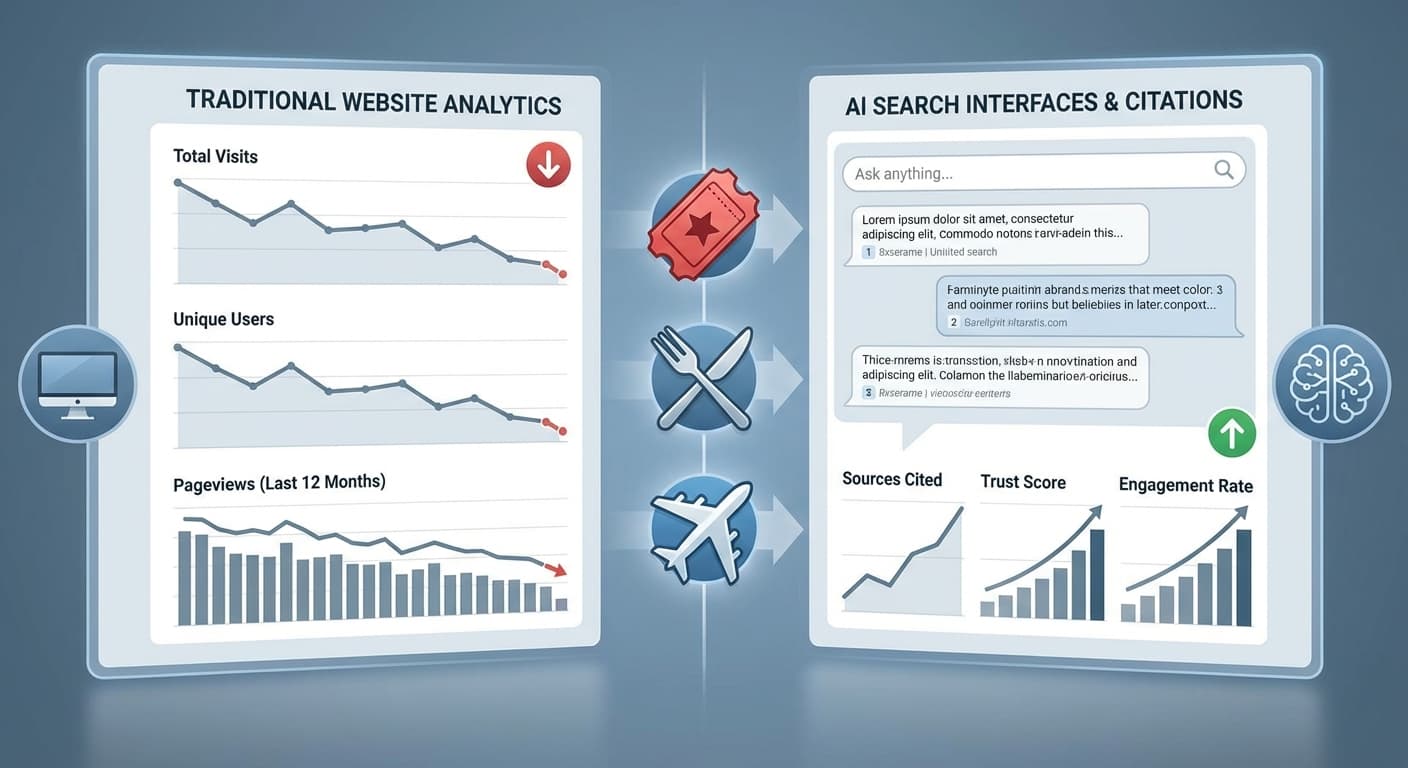
Here's a stat that should keep every business owner awake at night: 78% of all searches now go through AI engines like ChatGPT, Perplexity, Claude, and Gemini first. Yet 9 out of 10 businesses are still optimizing for traditional Google search as if it's 2020.
While you've been perfecting your keyword density and building backlinks, your potential customers have moved to a completely different playing field. They're asking AI chatbots for product recommendations, research insights, and buying advice—and if your content isn't optimized for these AI engines, you might as well be invisible.
The Dramatic Shift: How AI Search Changed Everything in 2025
The numbers tell a stark story. In just the past year:
This isn't a gradual shift—it's a seismic change that's already reshaping how customers discover, evaluate, and choose businesses.
What Happens When Your Content Isn't AI-Optimized: Real Case Studies
Case Study 1: TechStart Solutions
TechStart Solutions, a SaaS company with a $2M ARR, was dominating Google search for "project management software" throughout 2024. Their blog posts ranked in the top 3 for dozens of relevant keywords.
Then came 2025. Despite maintaining their Google rankings, their organic traffic plummeted 45%. Why? When potential customers asked ChatGPT "What's the best project management software for small teams?", TechStart wasn't mentioned once. Instead, AI engines cited competitors whose content was structured for conversational queries and semantic understanding.
The result: TechStart lost an estimated $800K in potential revenue before pivoting their content strategy.
Case Study 2: Mountain Gear Co.
This outdoor equipment retailer had built their content strategy around traditional SEO. Their product descriptions were keyword-stuffed but lacked the contextual depth that AI engines need to understand and cite content.
When customers asked Perplexity "What hiking boots are best for beginners on a budget?", competitors with AI-optimized content dominated the responses. Mountain Gear's products, despite being perfect fits, weren't even mentioned.
The pivot: After restructuring their content with conversational language, detailed use cases, and semantic richness, they saw a 67% increase in AI citations within 90 days.
The Revenue Impact: Companies Missing 40% of Their Target Audience
Recent research from the Digital Marketing Institute reveals that businesses not optimized for AI search are missing an average of 40% of their total addressable market. Here's why:
The New Customer Journey
If you're not visible in phases 1-3, you've lost the customer before they even know you exist.
The Compound Effect
Missing AI search visibility doesn't just cost you direct customers—it creates a compound effect:
5 Critical AI Optimization Strategies You Must Implement Now
1. Restructure Content for Conversational Queries
AI engines respond to natural language queries, not keyword phrases. Transform your content structure:
Before: "Best CRM software features comparison 2026"
After: "What CRM features should small businesses prioritize when choosing software?"
Action steps:
2. Enhance Semantic Richness
AI engines understand context and relationships between concepts. Your content needs semantic depth:
3. Implement Authoritative Citation Structures
AI engines prioritize content they can confidently cite. Make your content citation-worthy:
4. Optimize for Multiple AI Personalities
Different AI engines have different preferences:
Create content that satisfies all these preferences by being thorough, well-sourced, and thoughtfully structured.
5. Monitor and Iterate Based on AI Citations
Traditional SEO metrics don't tell the full story anymore. You need to track:
Future-Proofing Your Content Strategy for 2026 and Beyond
The Evolution Continues
AI search is just getting started. Industry experts predict:
Building an AI-First Content Strategy
To stay ahead:
Tools like Citescope can help you analyze your content's AI readiness through their GEO Score system, which evaluates content across five critical dimensions: AI Interpretability, Semantic Richness, Conversational Relevance, Structure, and Authority.
The Cost of Waiting
Every day you delay AI search optimization, competitors gain more AI visibility. By the time you catch up, they'll have established authority that's difficult to overcome.
Consider this: companies that optimized for AI search in early 2025 now enjoy:
How Citescope Helps
Optimizing content for AI search requires understanding how AI engines interpret and value your content. Citescope's AI Rewriter can transform your existing content with one-click optimization, restructuring it for better AI visibility while maintaining your brand voice.
The platform's Citation Tracker monitors when your content gets cited by ChatGPT, Perplexity, Claude, and Gemini, giving you real-time insights into your AI search performance. This data helps you understand what's working and what needs improvement in your AI optimization strategy.
Ready to Optimize for AI Search?
The AI search revolution isn't coming—it's here. While your competitors scramble to understand this new landscape, you can take the lead by implementing AI search optimization strategies today.
Start by analyzing your current content's AI readiness. Citescope offers a free tier with 3 optimizations per month, perfect for testing how AI search optimization can transform your content performance. Don't let another day pass with 78% of your potential customers unable to find you.
Try Citescope free today and see how AI-optimized content can revolutionize your business growth in 2026.